
India’s automotive market is entering a software-first era, with 95 percent of consumers willing to pay for Software-Defined Vehicle (SDV) capabilities such as safety, security and continuous vehicle health reporting, according to the 2026 Deloitte Global Automotive Consumer Study – India.

India stands out in next-generation mobility readiness, with 81 percent of consumers finding SDVs helpful and 84 percent willing to adopt AI-enabled customisation. The findings signal a structural shift in how Indian buyers define vehicle value – moving from hardware-led ownership to connected, upgradable and service-driven digital mobility. Strong openness to intelligent features, subscription-ready services and continuously evolving vehicle experiences positions India among the most promising global markets for software-led automotive transformation.
Safety, security and data trust take centre stage
Safety, security and trust are emerging as defining pillars of connected mobility adoption in India. Consumers prioritise protective and monitoring capabilities over convenience-focused digital features, reinforcing their willingness to pay for SDV-enabled services.
At the same time, India records the strongest global concerns around connected-vehicle data sharing. About 73 percent of consumers are concerned about personal device data, while 72 percent worry about vehicle location data. These findings reflect rising expectations around transparency, privacy safeguards and responsible data governance.
Rajat Mahajan, Partner and Automotive Sector Leader, Deloitte India, said, “India is stepping into a new era of mobility shaped by intelligence, sustainability and systemic innovation. Going forward, leadership in mobility will be defined not just by the scale of vehicles produced, but by the strength of the digital, energy and trust ecosystems that surround them. With its scale, technological depth and rapidly expanding innovation landscape, India has the potential to help shape the global direction of software-led, secure and sustainable transportation.”
Physical channels remain critical
Despite rapid digital transformation, physical engagement channels continue to play a pivotal role. Nearly 58 percent of consumers place the highest trust in dealers, underscoring the need for integrated physical-digital ownership journeys as vehicles become increasingly software-centric. India also reports the highest reliance on authorised dealerships for vehicle servicing.
The study highlights shifting consumer expectations across brand choice, purchase behaviour and engagement models.
Other emerging consumer and market trends
Purchase intent and engagement
Brand switching intent remains high at 70 percent, with 38 percent of consumers already having shifted brands in pursuit of new features and advanced technologies.
About 79 percent of consumers express interest in purchasing insurance directly from manufacturers, signalling growing acceptance of direct-to-consumer automotive models.
Digital research now dominates the purchase journey, with social media platforms and manufacturer websites serving as primary discovery and evaluation channels.
Powertrain transition
Internal Combustion Engine (ICE) vehicles continue to dominate next-purchase intent, while hybrids are emerging as the preferred transition technology.
Interest in Battery Electric Vehicles (BEVs) remains visible, with overall EV adoption intent rising slightly.
EV adoption dynamics
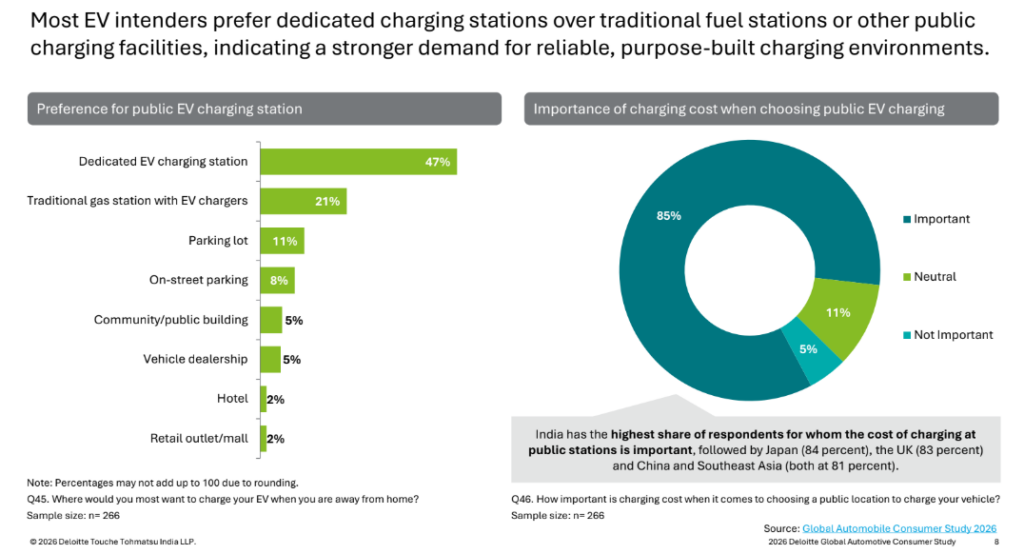
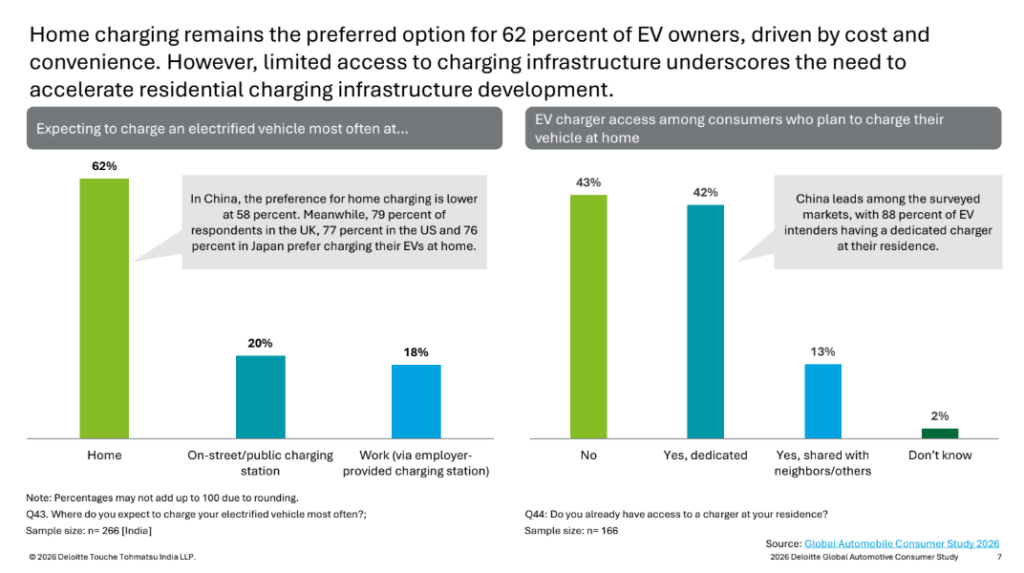
EV adoption in India is progressing at a measured pace, with intent remaining steady rather than accelerating. Ecosystem constraints continue to influence decisions, including concerns around public charging infrastructure (43 percent), charging time (41 percent) and battery safety and lifecycle issues (38 percent).
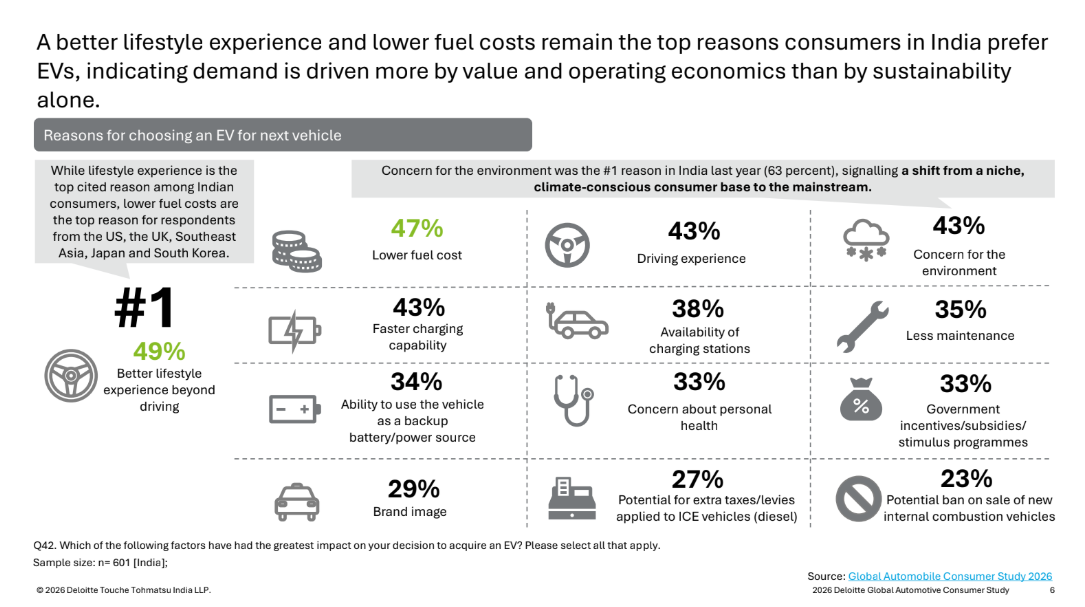
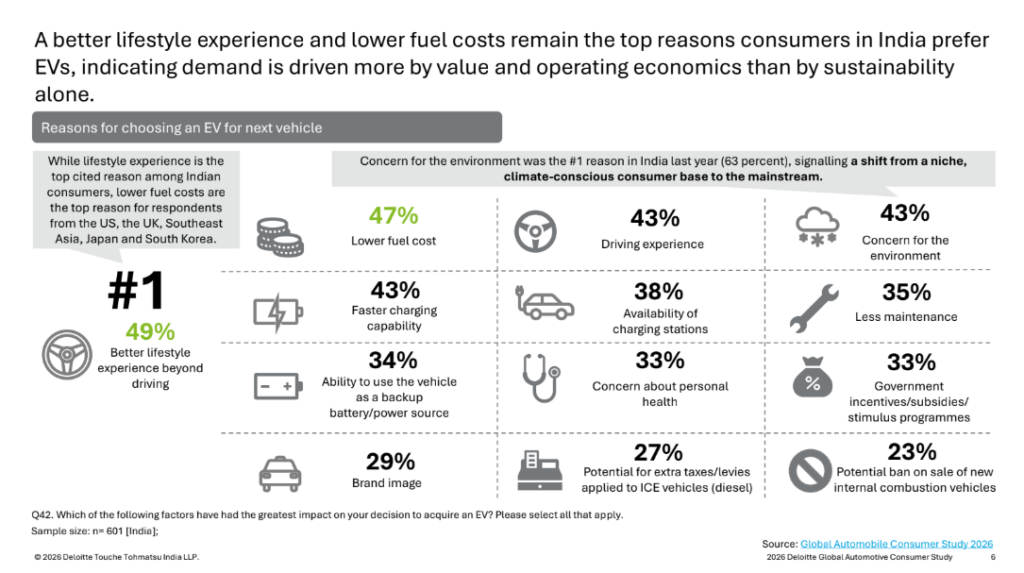
A strong preference for dedicated charging and high sensitivity to public charging costs underline the importance of infrastructure readiness. At the same time, EV appeal remains anchored in improved lifestyle experience and lower running costs.
Affordability and price expectations
Over three-quarters of consumers are willing to spend up to INR 25 lakh on their next vehicle, while more than half are prepared to spend up to INR 15 lakh.
The most significant growth in preference is seen in the entry-level INR 5 – 10 lakh price bracket, highlighting sustained demand for accessible yet feature-rich mobility solutions.
Payment preferences
UPI/QR continues to be the preferred method for public charging payments, reflecting the growing influence of India’s digital public infrastructure on mobility behaviour.
Overall, the findings suggest that India’s mobility evolution will be defined by software-led intelligence, safety-centric digital services and value-driven electrification. As digital trust, ecosystem readiness and affordability converge, India is poised to become a key global market in the transition towards connected, intelligent and continuously evolving transportation.