
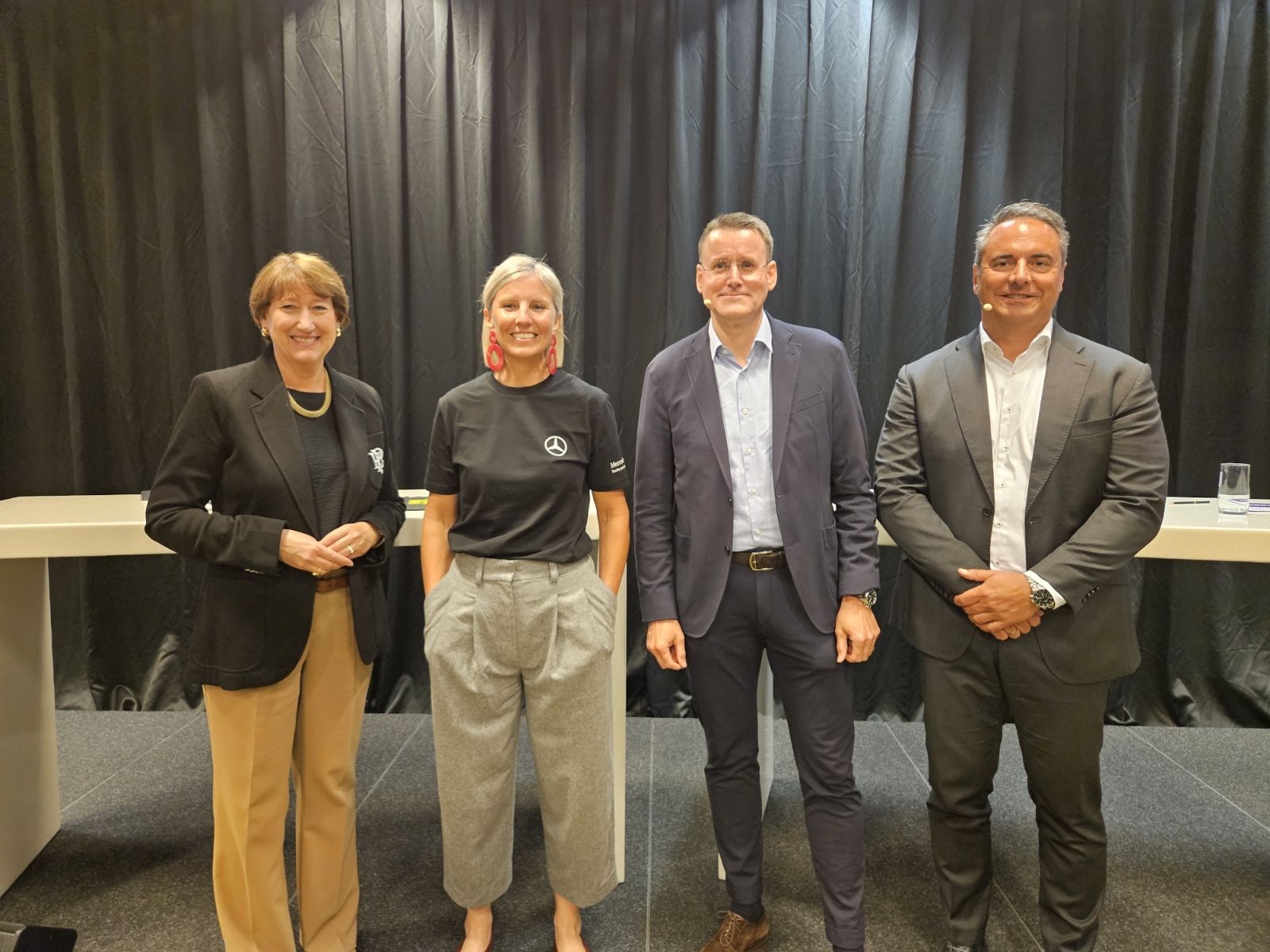
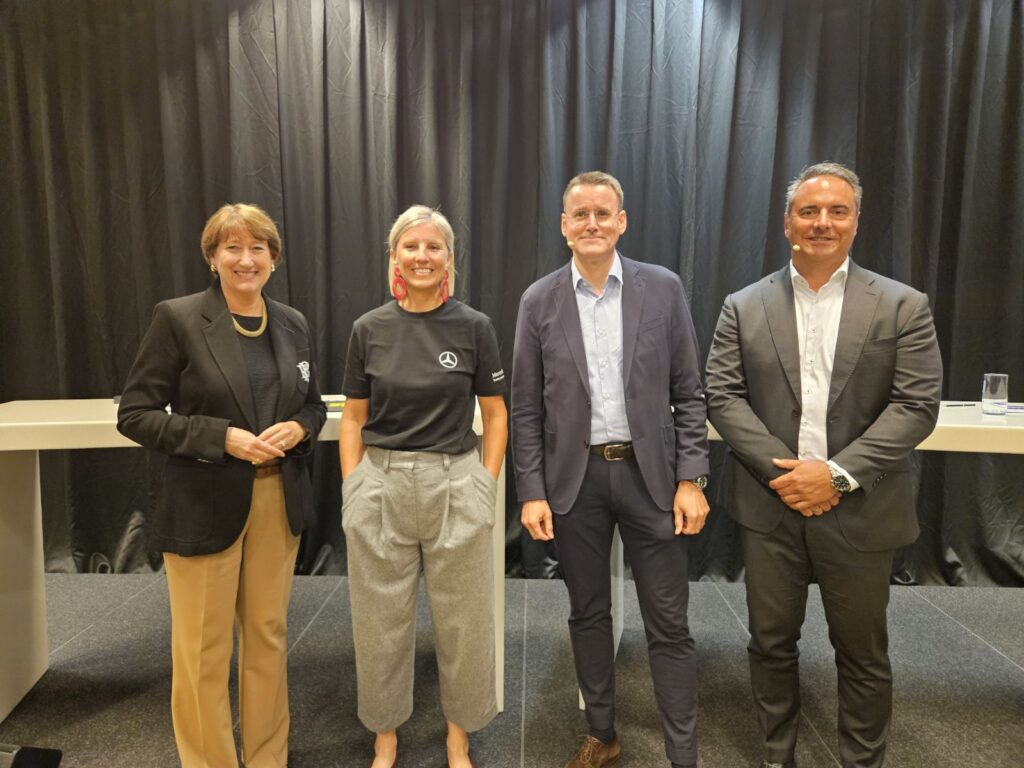
The opening panel discussion at the IAA Media Summit: Insights and Trends 2026 set the tone for this year’s event by highlighting a fundamental shift in the commercial vehicle industry’s decarbonisation journey. Bringing together Alexander Vlaskamp, CEO of MAN Truck & Bus, Karin Rådström, CEO of Daimler Truck, Dr. Roger Busch, Corporate EVP Sales & Engineering, MAHLE GmbH and Hildegard Müller, President of the VDA, the discussion moved beyond technology to focus on the ecosystem required to make sustainable transport commercially viable.
A common thread throughout the session was that the industry is no longer debating whether sustainable mobility will become a reality, but how quickly the supporting ecosystem can evolve to keep pace with technological progress. Electrification, hydrogen, autonomous driving and digitalisation have advanced rapidly, but speakers agreed that infrastructure, regulation and business readiness continue to lag behind.
Infrastructure Must Match Innovation
Alexander Vlaskamp emphasised that truck manufacturers have largely delivered on their side of the transition. Significant investments have already been made in battery-electric and hydrogen-powered trucks, yet charging infrastructure and hydrogen refuelling networks remain insufficient across Europe. He pointed out that ambitious CO₂ reduction targets cannot be achieved unless the enabling conditions; including charging availability, stable energy costs and supportive policy measures; progress in parallel. In his view, regulations and real-world operating conditions need to move in sync if fleet operators are to confidently invest in zero-emission vehicles.
Echoing this concern, Karin Rådström observed that Europe’s policy discussions have evolved from focusing solely on climate ambitions to recognising the importance of industrial competitiveness. However, she cautioned that while the mindset is changing, implementation has yet to match the pace of discussion. Simplifying regulations, improving infrastructure and creating commercially viable operating conditions are now just as important as setting ambitious environmental targets. Rådström also highlighted autonomous trucking as the next major transformation, noting that commercial deployment in the United States is approaching and will eventually pave the way for wider adoption in Europe as technology and regulations mature.
Technology Neutrality Takes Centre Stage
The discussion also reinforced the importance of technology neutrality. Dr. Roger Busch argued that the transition cannot rely on a single propulsion technology. Instead, battery-electric vehicles, hydrogen solutions, efficient combustion engines, range extenders and other low-carbon technologies will all have roles to play depending on duty cycles, operating conditions and regional infrastructure. From a supplier’s perspective, he stressed that predictable regulations and planning certainty are essential to justify long-term investments in new technologies and manufacturing capacity. As transport requirements continue to evolve, flexibility rather than a one-size-fits-all approach will be key.
Competitiveness Will Determine Success
While technology dominated much of the discussion, Hildegard Müller shifted the focus towards Europe’s broader industrial landscape. She underlined the need to strengthen competitiveness through affordable energy, resilient supply chains, secure access to raw materials and pragmatic industrial policies. Decarbonisation, she argued, should not come at the expense of Europe’s manufacturing base. At the same time, she advocated greater resilience without abandoning global cooperation, emphasising that international collaboration remains essential even as industries diversify supply chains and reduce strategic dependencies.
Competitiveness emerged as another recurring theme across the panel. Alexander Vlaskamp maintained that European truck manufacturers continue to hold strong positions in global markets, but preserving that leadership will require an ecosystem that supports innovation rather than constrains it. Karin Rådström echoed this sentiment, noting that Europe already possesses world-class engineering capabilities and technological expertise; the challenge now lies in translating these strengths into faster execution through coordinated action between industry and policymakers.
The conversation also highlighted the growing influence of software-defined vehicles and autonomous driving on the future of freight transport. While autonomous technologies are advancing rapidly, speakers agreed that their widespread deployment will depend not only on technical maturity but also on supportive regulatory frameworks, digital infrastructure and public acceptance. Digitalisation is expected to play an increasingly important role in improving safety, operational efficiency and fleet productivity across the commercial vehicle sector.
By the close of the session, one message stood out clearly. Innovation alone will not determine the success of the industry’s transition. The future of commercial transport will depend on how effectively technology, infrastructure, regulation and competitiveness are aligned into a coherent ecosystem.
For markets such as India, the discussion offered valuable lessons. As the country accelerates its own journey towards cleaner mobility, it has an opportunity to ensure that vehicle technologies, charging infrastructure, policy support and commercial viability evolve together. Europe’s experience suggests that success will depend not only on ambitious targets but also on creating the ecosystem needed to make those ambitions practical and profitable.