
The global electric commercial vehicle market, according to MarketsandMarkets, is on a steep upward curve — set to more than double from $84.64 billion in 2026 to $197.55 billion by 2033, growing at a CAGR of 12.9%.
Electric commercial vehicles have moved past the experiment stage. The industry has made its decision — and now it is simply a matter of how fast things will move. From small delivery vans in city lanes to heavy trucks on regional highways, electric transport is growing faster than most people expected even five years ago.
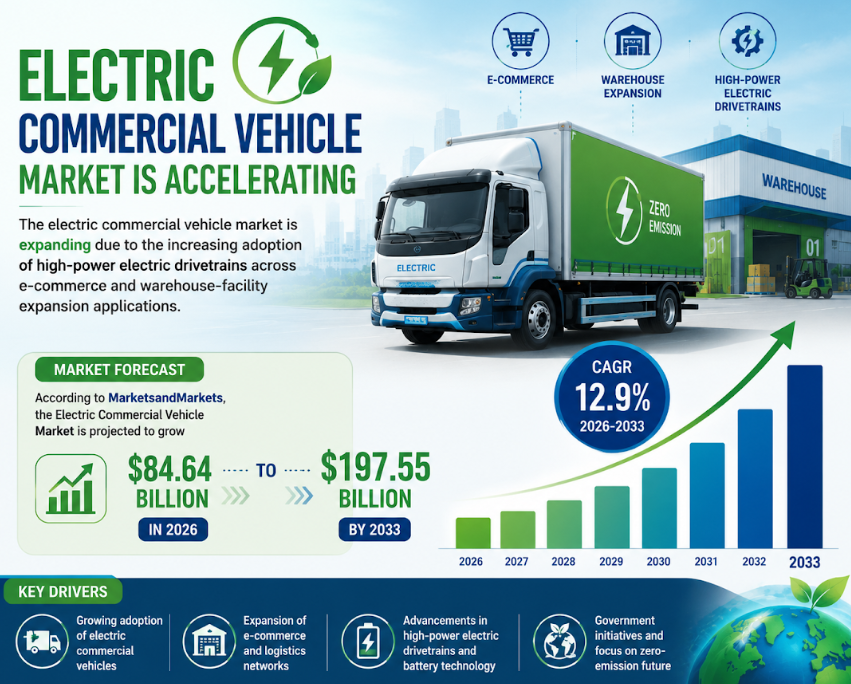
The numbers back this up. According to MarketsandMarkets, the global electric commercial vehicle market is projected to grow from $84.64 billion in 2026 to $197.55 billion by 2033, at a compound annual growth rate of 12.9%. That is not incremental growth — it is a fundamental reshaping of how goods and people are moved.
The Urban Opportunity
The clearest and most immediate growth story is in urban logistics. Vehicles with power outputs below 100 kW — compact electric light commercial vehicles used for last-mile delivery, municipal services, and short-distance freight — are leading the charge. And for good reason. These vehicles are ideally suited for the stop-and-go conditions of city driving, where regenerative braking recovers energy that would otherwise be wasted, and where the relatively short distances travelled each day mean that modest battery packs are perfectly adequate.
Fleet operators have recognised this. The economics of running a sub-100 kW electric delivery vehicle in a city are compelling — lower energy costs, reduced maintenance, and operating profiles that align naturally with overnight depot charging. The rise of e-commerce has only accelerated this. As delivery networks expand and urban logistics demand grows, the case for electrifying the last mile becomes harder to ignore.

In India, Tata Motors has been among the leaders, deploying the Ace EV for urban cargo and e-commerce logistics. Globally, BYD and FAW are integrating compact electric platforms with telematics, predictive maintenance systems, and smart battery management to support efficient urban operations. Modular drivetrain architectures and localised battery sourcing are making these vehicles progressively more affordable and easier to scale.
The Middle Distance
While urban delivery is the immediate growth engine, the segment covering 240 to 480 kms of range is where the electric commercial vehicle market is building its most durable foundations. This range band has emerged as the sweet spot for regional logistics, urban freight movement, and public transportation — distances that are too long for light urban vehicles but short enough that battery capacity does not become prohibitive.
What makes this range segment particularly attractive is its compatibility with existing charging infrastructure. Depot charging and DC fast charging both work well for vehicles in this category, reducing downtime and keeping infrastructure costs manageable. The vehicles themselves benefit from advances in lithium iron phosphate and nickel manganese cobalt battery chemistries, improved thermal management systems, and efficient electric drivetrains that together deliver reliable performance across a full working day.
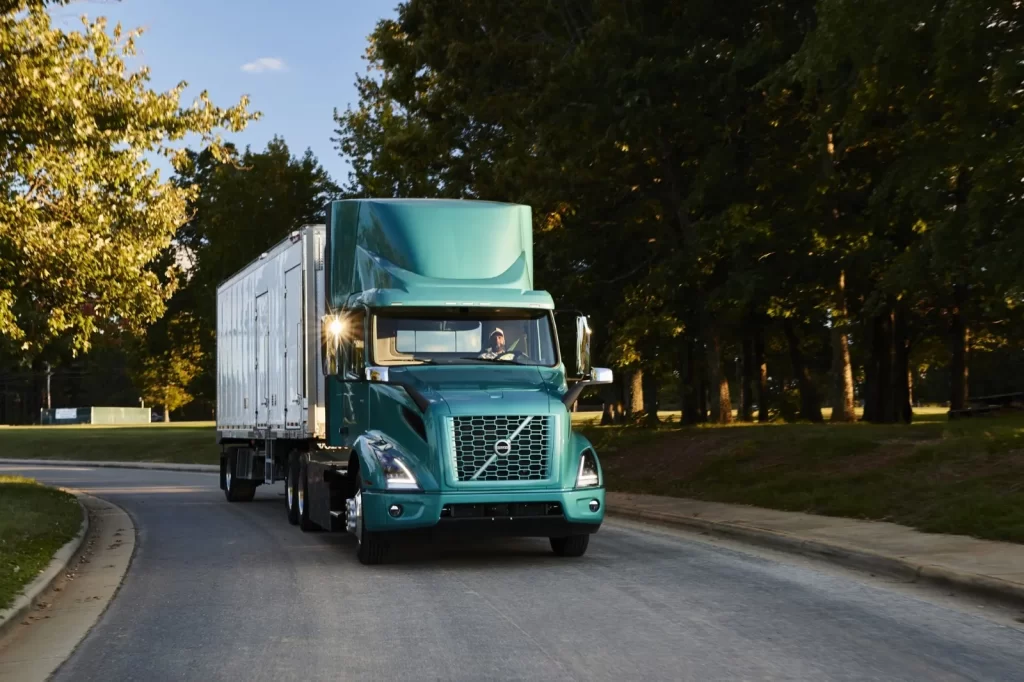
Global manufacturers have taken note. The BYD 8TT and the Volvo VNR Electric are both designed for this range category, serving regional freight and urban distribution with integrated energy management and fleet monitoring. These are not experimental vehicles — they are production models, deployed at commercial scale, doing real work.
Europe’s Regulatory Push
In Europe, the electric commercial vehicle transition is being accelerated by a combination of decarbonisation targets, zero-emission transport regulations, and expanding charging infrastructure. Low-emission zones in major European cities have made the switch to electric vans and trucks not just preferable but necessary for fleet operators who want to continue operating in urban centres.
Light commercial vehicles are growing fastest, driven by e-commerce delivery networks and the proliferation of electric vans for last-mile logistics. In the heavier segments, AB Volvo is expanding deployment of the Volvo FH Electric and Volvo FM Electric for regional freight, while Daimler Truck is building out its portfolio through the Mercedes-Benz eActros platform. In buses, BYD and Yutong are rolling out connected electric vehicles with fast-charging compatibility and intelligent fleet monitoring across European cities at increasing pace.
The Road Ahead
What is striking about the electric commercial vehicle market is how quickly the conversation has shifted. The technology questions — range, reliability, charging, payload — are largely being answered through experience and innovation. The remaining barriers are primarily economic and infrastructural, and both are responding to investment and policy support.
For fleet operators, the calculus is increasingly straightforward. Lower operating costs, improving total cost of ownership, expanding charging networks, and growing regulatory pressure are all pointing in the same direction. The question is no longer whether commercial transport will electrify — it is how quickly each segment will follow the path that urban last-mile delivery has already begun to chart.