
Asia-Pacific commands 43.58% of the global commercial tyre market, driven by booming vehicle production, expanding infrastructure, and strong freight demand across China, India, Japan, and Southeast Asia.
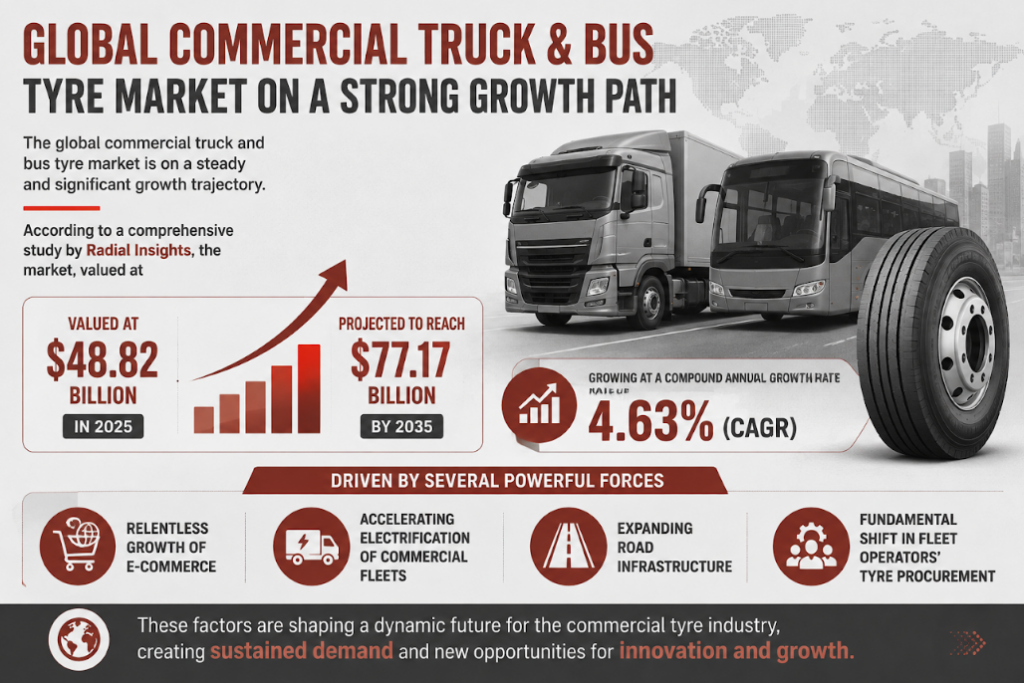
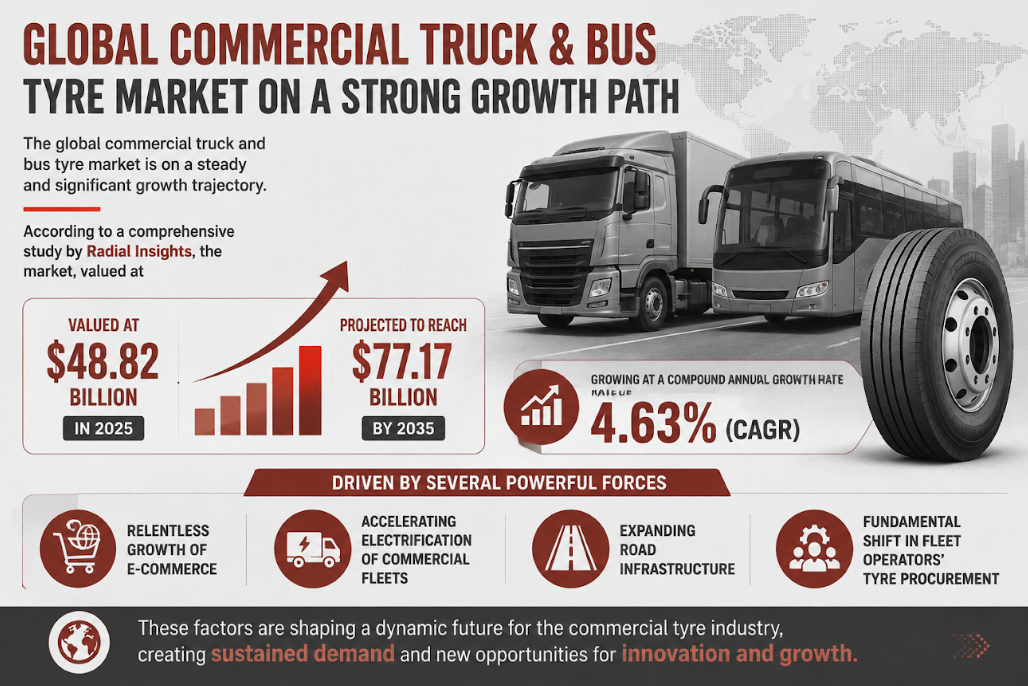
The global commercial truck and bus tyre market is on a steady and significant growth trajectory. Valued at $48.82 billion in 2025, it is projected to reach $77.17 billion by 2035, growing at a compound annual growth rate of 4.63%, according to a comprehensive study by Radial Insights. The numbers reflect an industry that is being pulled forward by several powerful forces at once — the relentless growth of e-commerce, accelerating electrification of commercial fleets, expanding road infrastructure, and a fundamental shift in how fleet operators think about tyre procurement. This is no longer a simple replacement market. It is becoming a strategic one.
E-Commerce Drives Everything
According to the recent report by Radial Insights, the most immediate and measurable driver of tyre demand growth is the global explosion of e-commerce and last-mile delivery. Global retail e-commerce sales are expected to total approximately $6.42 trillion in 2025, and the delivery fleets required to fulfil those orders are growing at a pace that directly translates into tyre consumption. Amazon operated more than 52,700 electric delivery vans globally in 2025, delivering 2.4 billion packages electrically. DHL expanded its electric pickup-and-delivery fleet to approximately 45,400 vehicles, while FedEx’s US network included around 40,000 vehicles.
Urban delivery routes are particularly demanding on tyres. Frequent braking, tight turns, and constant acceleration and deceleration in stop-start traffic dramatically accelerate tread wear and create pressure on casings that long-haul highway tyres are not designed to endure in the same way. This is driving specific demand for reinforced casings, retreadable designs, and tyre specifications built for the unique stresses of urban last-mile operations. Radial Insights estimates that e-commerce and last-mile delivery expansion alone could contribute approximately 1.4 percentage points to the market’s compound annual growth rate through 2035 — a substantial contribution from a single end-use trend, the report stated.
Infrastructure Unlocks Freight
Alongside e-commerce, infrastructure investment is a powerful underlying driver of commercial tyre demand. In the United States, the Bipartisan Infrastructure Law committed approximately $550 billion in new federal investment to roads, bridges, and freight corridors. In India, the national highway network has expanded to 1,46,560 kilometres. Greater corridor capacity means more trucks moving more freight more efficiently — and more tyres being consumed in the process.
Higher truck utilisation rates translate directly into shorter tyre replacement cycles, because commercial tyres wear at a rate that is largely determined by distance travelled and load carried. As infrastructure improves and freight volumes grow, replacement demand accelerates alongside it.
Radial Rules, Retreads Rise
Within the market, radial steel-belted tyres dominate, driven by their superior durability, fuel efficiency, and retreadability — all of which are increasingly important as operators focus on total cost of ownership rather than just purchase price. Bias ply tyres retain relevance in legacy and cost-sensitive fleets, but the direction of travel is clearly toward radial construction.
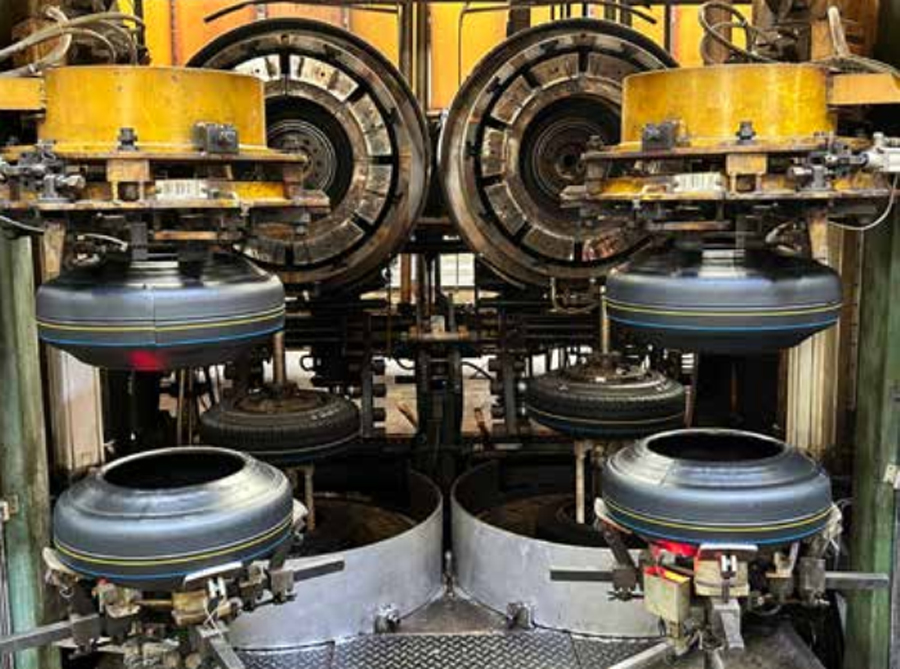
Retreading is the market’s most interesting subplot. Approximately 15 million tyres are retreaded annually in the United States, representing nearly 44% of commercial truck tyres in the US and Canada. In Europe, retreads accounted for around 20% of the truck replacement market. A retread typically costs 30 to 50% less than a comparable new tyre, making it an economically compelling choice for cost-conscious fleet operators. Radial Insights estimates that retreading creates a 0.7 percentage point drag on new-tyre compound annual growth rate — but it also supports premium casing demand and aligns with circular economy strategies that are increasingly important to large fleet operators with sustainability commitments.
Fleet Intelligence Emerges
Perhaps the most significant structural shift in the commercial tyre market is the way procurement decisions are being made. Tyres are no longer simply ordered when worn out and replaced with whatever is available. Fleet operators are increasingly evaluating tyres across a basket of criteria that includes fuel efficiency, casing life, retreadability, compatibility with electric vehicles, and digital monitoring capability.
Tyre-as-a-Service models are emerging, where operators pay for tyre performance rather than tyre ownership. Fleet management platforms integrate tyre data — pressure, temperature, tread depth, mileage — into broader operational dashboards that support predictive maintenance and lifecycle cost optimisation. This shift is being driven by the economics of large fleets, where even marginal improvements in tyre performance and uptime translate into meaningful cost savings at scale.
Mr. Lucas Harrison, lead automotive and heavy transportation analyst at Radial Insights, captured the shift stating that commercial tyre procurement is becoming a fleet productivity decision rather than a simple replacement purchase, with operators now evaluating fuel efficiency, casing life, retreadability, digital monitoring, and EV compatibility together. Suppliers that combine durable products with measurable total-cost-of-ownership savings will be best positioned through 2035.
Geographies and Segments
Asia-Pacific leads the global market with a 43.58% share, driven by commercial vehicle production, infrastructure expansion, and strong freight demand across China, India, Japan, and Southeast Asia. North America holds 23.90%, with fleet modernisation, advanced logistics networks, and widespread retreading driving steady demand. Europe accounts for 18.10% and remains a global leader in sustainability and circular tyre practices. Latin America, the Middle East, and Africa together account for the remaining share, with growth potential linked to infrastructure development and fleet expansion.
Within vehicle segments, Class 8 heavy trucks — those above 33,000 pounds (about 15,000 kgs) gross vehicle weight — generate the highest tyre demand, driven by their dominance in long-haul freight and heavy payload operations. Electric buses and heavy trucks represent the fastest-growing opportunity, as fleet operators and transit authorities commit to electrification programmes that require tyres designed for the specific weight, torque, and heat characteristics of electric drivetrains.
The Road Ahead
The commercial tyre industry is being reshaped by forces that reinforce one another. E-commerce growth drives fleet expansion. Fleet expansion drives electrification. Electrification creates new tyre specifications. Digital fleet management raises the bar on performance measurement. And sustainability commitments push operators toward retreading, premium casings, and suppliers who can demonstrate a measurable environmental footprint.
The tyre companies best positioned for 2035 will not simply be those with the largest manufacturing capacity. They will be those that combine product durability with digital capability, total-cost-of-ownership transparency, and the agility to serve both conventional and electric fleets as the market continues its rapid evolution, the report added.
NB: Photos are representational; report courtesy: Radial Insights.