
Progress does not wait for the perfect moment. It belongs to those who see possibility where others see limits — and have the courage to move before the future arrives, says, Mr. Shailesh Chandra.

Some companies build cars. Tata Motors Passenger Vehicles (TMPV) has spent more than three decades building something far more enduring — a relationship with India itself. And at the heart of this story is a number that carries enormous weight — seven million. Seven million cars on Indian roads. Seven million families who chose to make Tata a part of their lives. But to understand what seven million truly means, you have to go back to where it all began.
Humble Beginnings
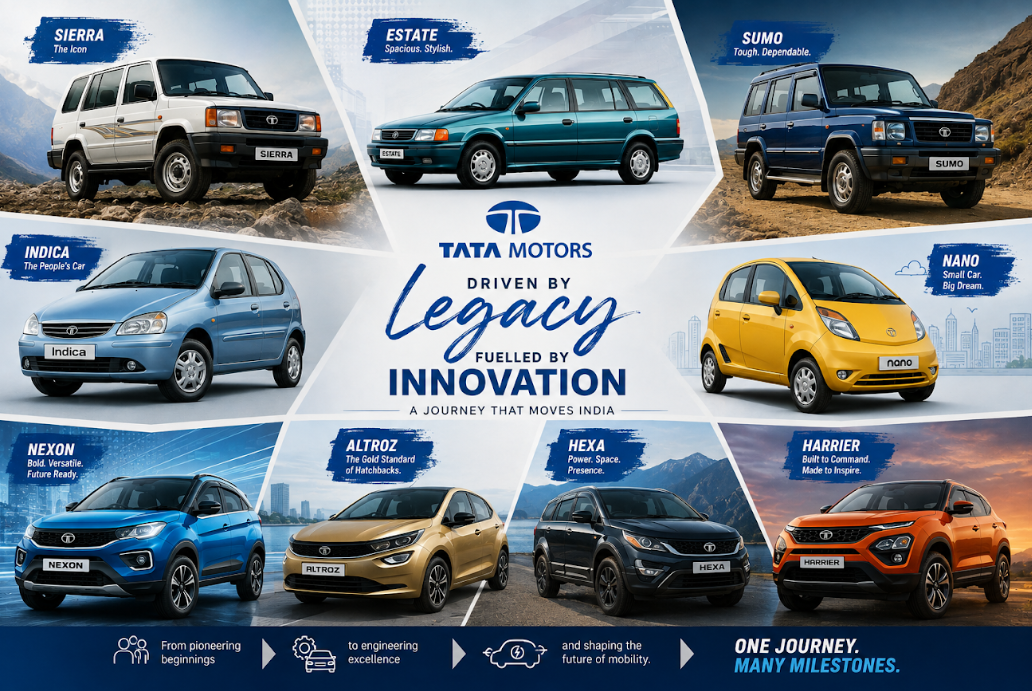
The journey began with a strong belief that if innovation can improve people’s lives, it should not remain the privilege of a few. That conviction gave India the Tata Sierra — Tata Motors’ (earlier known as Tata Engineering and Locomotive Company – TELCO) first passenger vehicle — in 1991. The Estate and Sumo followed in 1994, broadening the portfolio.
The real inflection point came in 1998, when the vehicle maker presented India’s first indigenously developed passenger car, the Tata Indica, at the Geneva Motor Show. As the authentic ‘Indian car,’ it quickly topped the Indian market within two years. The Indica, with the tagline: “More car per car,” became a statement of self-reliance, and it gave the OEM the confidence to dream bigger. The Safari, launched the same year, followed close behind — becoming a symbol of aspiration and adventure, defining the SUV lifestyle for an entire generation of Indians.
The Nano Nightmare and the Dark Years
In 2003 the company adopted the name Tata Motors Limited to better reflect its core automotive business rather than general engineering. Flush with success, Tata Motors unveiled the Nano in 2008 — the world’s cheapest car at ₹1 lakh, dreamt up to put two-wheeler families on four wheels. Though the idea was visionary, the execution was painful. Production plant relocation, engine fires, poor build quality, and reliability concerns battered its reputation early on. But the deepest wound was perception — aspirational Indians refused to be seen in the world’s cheapest car. The Nano was quietly discontinued in 2018.

Mr. Shailesh Chandra, MD and CEO, TMPV
The Indica’s success proved equally short-lived. Safety concerns, fierce competition, and the failures of the Sumo and Indigo eroded market share steadily, leaving the company passenger vehicle business badly bruised by the early 2010s.
Safety and the Turnaround
In 1997, Tata Motors had established India’s first crash testing facility in Pune — years ahead of the industry. The payoff came in 2018 when the Nexon became India’s first car to earn a five-star Global NCAP rating, shifting safety from engineering discussions to family conversations and raising standards across the industry.
The turnaround had already begun with the Tiago in 2016, followed by the Nexon, Altroz, and Harrier — together accounting for 60% of Tata’s sales in FY2021. The Punch arrived in 2021, single-handedly creating the micro-SUV segment and leading Tata’s portfolio with 20,208 units sold in May 2026, contributing 34.2% of total monthly sales.
The Electric Leap and Sierra’s Return
Alongside its product revival, Tata Motors built an entire electric mobility ecosystem. The Nexon EV launched in 2020, followed by the Tiago EV, Punch EV, and Curvv EV — offering the market with its widest EV portfolio from a single manufacturer. Then came a moment of full circle — the Sierra returned in Q3 FY26, the nameplate that started it all, reborn as a modern SUV with an EV version close behind.
Seven Million and Counting
Tata Motors started building passenger vehicles in 1991. The brand achieved the one million production milestone in 2004, the second million in 2010, crossed three million in 2015, and four million in 2020. From four million to seven million in just six years — the pace of growth tells its own story.
Thirty-five years — that is how long it has taken to go from a single vehicle — the Sierra — rolling out of a Pune factory, to seven million cars on Indian roads. From a company finding its feet in passenger vehicles to one that has pioneered safety, led the electric revolution, and built some of India’s most admired SUVs — it is, at its core, a story of rough-patches and resilience, of lessons learned the hard way, and of a company that refused to give up on its belief that world-class mobility could be built in India, for India.
And it is precisely at this moment — with momentum at its highest and also Tata Motors demerger in October 2025 (separating CV and PV businesses) — that TMPV has chosen to take its next step. Not just with a new product, but with a new identity that reflects everything the journey has stood for, and everything that lies ahead.
A Name India Already Gave Us
According to Mr. Shailesh Chandra, MD and CEO, TMPV, seven million cars sales is not a destination. It is a springboard — and it is the backdrop against which TMPV has chosen to unveil something new. When an Indian family brought home a new vehicle, they never called it a hatchback or an SUV. They simply said: “We bought a Tata car. Those words carried the reassurance of the Tata name, the pride of Indian engineering, and the confidence that the car had been created with a deep understanding of India and its people. In many ways, TATA.CARS is not a name automaker invented. It is a name India gave them. Today, we are simply making it official,” Mr. Chandra said.
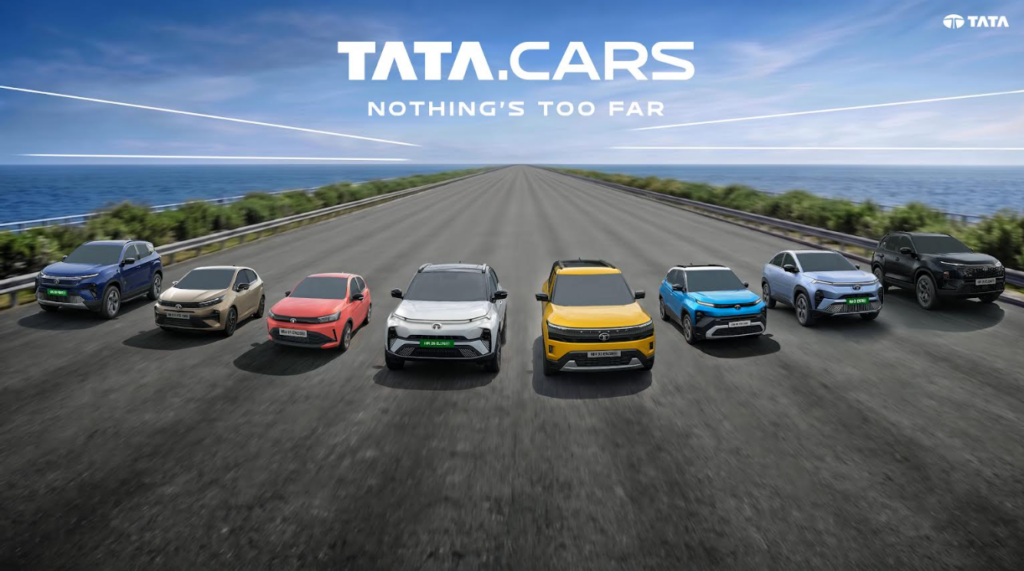
As he puts it, “progress does not begin when every challenge has been solved. It begins when someone has the courage to see possibility where others see limitations, and the conviction to move forward before the future arrives. This has always been the Tata Motors story — seeing possibilities before they become obvious, understanding what customers will need before they even ask, and turning bold ideas into meaningful progress,” he explained.
Next Chapter
The road ahead is being shaped for a fundamentally different generation — more confident, more expressive, and more ambitious than any before it. A generation that does not just want great products. It wants brands that reflect who they are and what they stand for.
And as India looks ahead — more restless and aspirational than ever — the promise at the heart of TATA.CARS could not be more fitting. For every family beginning a new chapter, for every dream that refuses to be limited by circumstance, and for every journey India is yet to imagine, a Tata car will be there to make it possible, he said.
“The name is new. The belief behind it is not. It is the same conviction that has guided the company from its very first car to its seven millionth — that mobility should open doors, expand possibilities, and help people go further than they ever imagined. Because when India sits in a Tata car, nothing’s too far,” Mr. Chandra concluded.
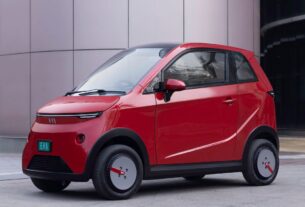
NB: The first photo is for representational purpose only.