


For India’s EV owners, the real test begins after purchase—when everyday charging, reliability and convenience shape the true ownership experience.
India’s electric mobility journey is moving into a decisive stage, according to the 2025 HERE–SBD EV Index. The study shows a fast-maturing EV ecosystem driven by strong consumer demand, changing State-level performance, and growing strain on charging infrastructure.
Consumer sentiment remains highly positive. India has the youngest EV owners among surveyed regions, with an average age of 35. Nearly 90% are optimistic about charging infrastructure growth, and many expect internal combustion engines to phase out within the next 10–15 years. However, everyday challenges persist. About 73% of EV owners have faced faulty chargers, and nearly half still see the lack of public charging as the biggest barrier to adoption.
Youth Power Meets the Charging Challenge
India’s electric vehicle surge is being led by young, urban buyers—but the charging network is struggling to keep up. Mr. Abhijit Sengupta, Senior Director and Head of Business for Southeast Asia and India at HERE Technologies, says demand for EVs is rising fast, especially among first-time and city users. Yet range anxiety remains a major concern, driven by gaps in charging availability and reliability.
The 2025 HERE–SBD EV Index clearly shows this mismatch. The ratio of battery electric cars to public chargers has worsened from 12:1 in 2024 to 20:1 in 2025. Even though India added 6,800 new public chargers in a year, average charger power has remained stuck at 33 kW, limiting faster adoption. He believes that infrastructure can begin to catch up within three to five years if focus shifts to three priorities: installing higher-power chargers, ensuring better maintenance and uptime, and planning charger locations using real mobility data. Government programmes like PM E-DRIVE, which aims to add over 72,000 public chargers by FY28, will be key to this transition.
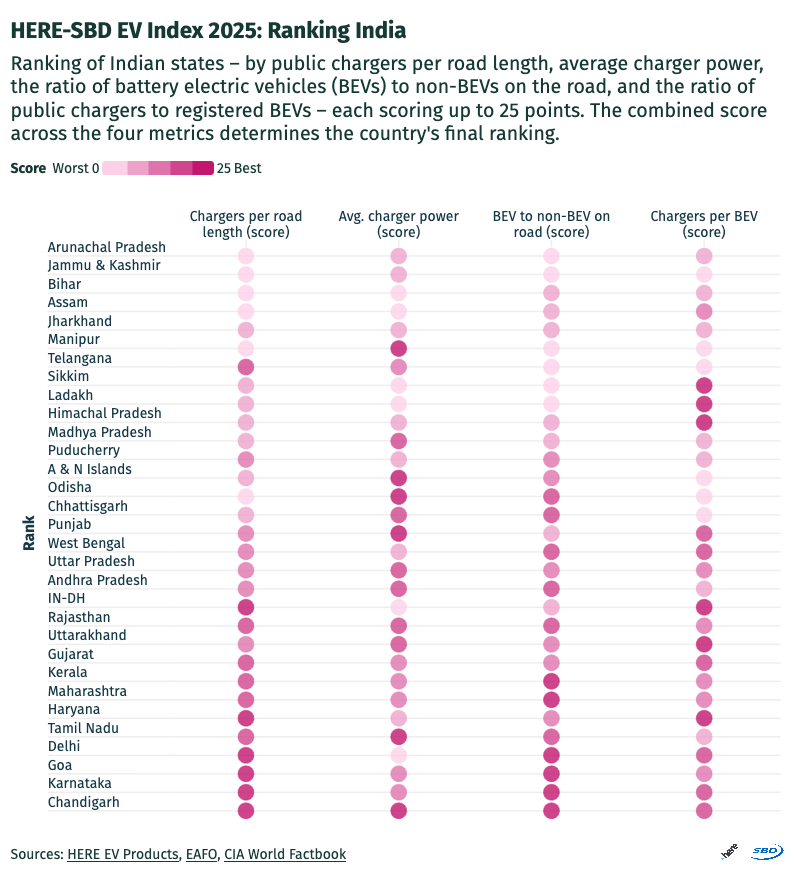
The Index also explains why some States surge ahead while others fall behind. Leaders such as Chandigarh, Karnataka and Goa show a strong mix of supportive policies, faster infrastructure rollout and growing EV adoption. Chandigarh tops the rankings with a score of 87.90, helped by its compact size, dense population and clear zero-emission policies. Karnataka has climbed to second place, balancing rapid EV adoption with relatively better charger availability. Goa leads in EV fleet share, reflecting early consumer acceptance.
Together, these States show that when policy, infrastructure and consumer demand move in sync, EV readiness accelerates—offering clear lessons for the rest of the country, he said.
Fixing the Everyday EV Frustrations
For many EV owners in India, the biggest challenges are not about buying the vehicle, but about living with it every day. The HERE–SBD EV Index reveals that 73% of EV users have faced failed charging attempts, while 47% say the lack of available chargers is the single biggest barrier to wider adoption.
The solution, he says, lies in building not just more chargers, but better ones. Reliable infrastructure backed by predictive maintenance, remote monitoring and clear uptime standards can sharply reduce charger failures. When chargers work consistently, confidence follows.
Slow charging speeds and long waiting lines are equally frustrating. These can be eased by rolling out more fast and ultra-fast chargers, especially along highways, and by using smart load management to balance power demand. Expanding charging points in high-traffic locations such as malls, offices, parking areas and housing complexes will also help reduce queues.
Technology can play a powerful role here. Navigation platforms that show real-time charger availability, compatibility and booking options can help drivers plan better and avoid congestion. “Additionally, smarter traffic-based planning and broader access to battery swapping – especially for two-wheelers and commercial fleets, can further ease bottlenecks, avoid range anxiety and ensure enjoyable driving experiences,” Mr. Sengupta adds.
After FAME II: A Sharper, Smarter EV Push
With the end of FAME II, India’s EV policy has entered a more focused phase through the PM E-DRIVE scheme. Backed by an outlay of ₹10,900 crore between October 2024 and March 2026, the new programme shifts from broad incentives to targeted action where impact is highest—two- and three-wheelers, electric buses, ambulances, and commercial EVs.
PM E-DRIVE also puts strong emphasis on charging infrastructure, he says. It supports the rollout of over 72,000 fast chargers across cities and highways, while offering incentives for EV purchases. Building on earlier efforts, the scheme introduces digital tools that help users locate, access, and pay for charging more easily—making EV ownership simpler and more dependable.
At the same time, policymakers recognise that India’s transition cannot rely on a single fuel or a one-size-fits-all plan. The country is moving toward a multi-fuel future that includes EVs, hybrids, CNG, biofuels, LNG and hydrogen. Each vehicle segment has different needs. Two- and three-wheelers depend on low-cost solutions like battery swapping and affordable charging. Cars need fast and ultra-fast chargers along urban roads and highways. Buses and commercial vehicles, which travel long distances, may rely on high-capacity charging, hybrids, or hydrogen.
This is why differentiated charging and policy strategies are essential, he points out. Tailoring infrastructure to how each segment is used will reduce range anxiety, improve efficiency, and ensure that India’s EV transition grows in a balanced, practical and inclusive way.
Local Roots for a Lasting EV Future
For India’s electric shift to truly last, localisation is not optional—it is essential, Mr. Sengupta says. Today, many critical EV parts such as battery cells, high-voltage power electronics and core software still come from overseas, exposing manufacturers to supply risks and higher costs. Building these capabilities within India will reduce import dependence and make EVs more affordable over time.
Developing strong Tier-1 and Tier-2 suppliers, investing in in-house technologies like Battery Management Systems, Vehicle Control Units and motors, and supporting local EV component makers will create a stronger, more reliable supply chain. Beyond cost and security, localisation will also drive industrial growth and jobs—ensuring India’s EV journey is resilient, sustainable and built for the long run, he concludes.