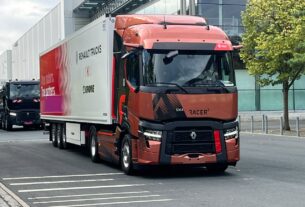

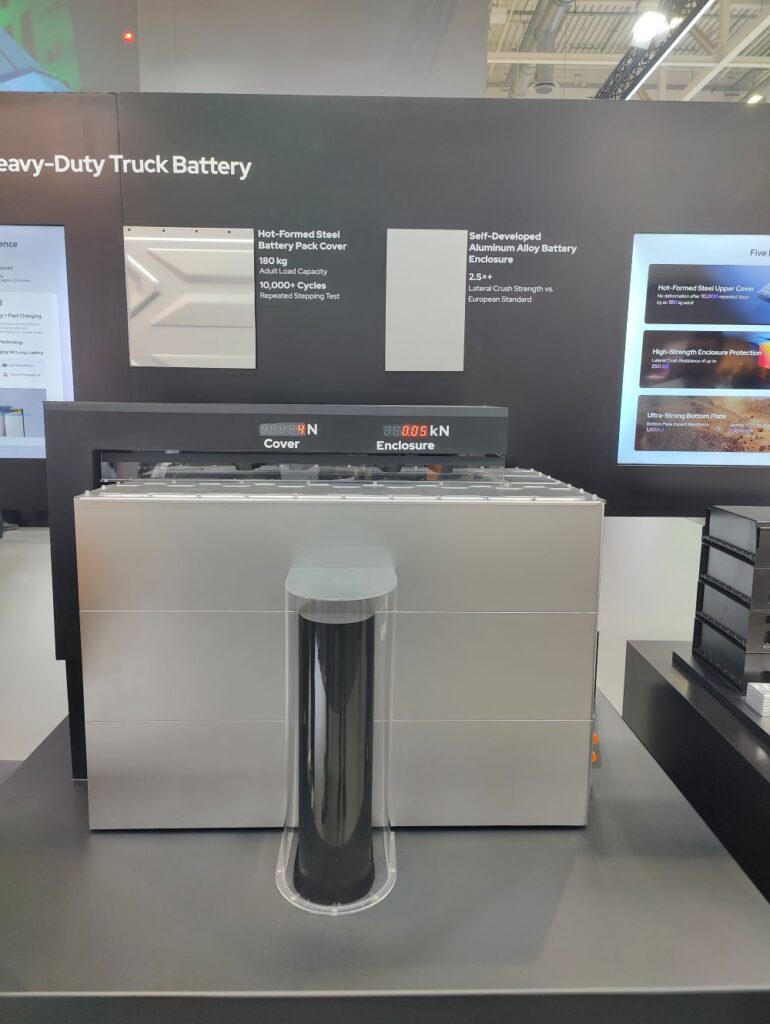
Contemporary Amperex Technology Co., Limited (CATL) has unveiled the second generation of its heavy-duty truck battery pack, nicknamed the “Magic Cube.” The system called TECTRANS II, is designed to make vehicle integration much simpler. It roughly halves the number of components, cuts vehicle development time by 50% and lowers R&D costs by 60–70%.
The new pack marks a clear shift from CATL’s earlier approach. Previously, manufacturers received individual battery packs and had to connect them into a single string themselves, which meant numerous coolant lines, voltage connections and complex interface work. The integrated design reduces this to one high-voltage connection, one low-voltage connection and two cooling lines. That simplifies assembly and frees up space on the vehicle while keeping the same energy capacity. The pack is slightly heavier, however, because of its more robust structure.
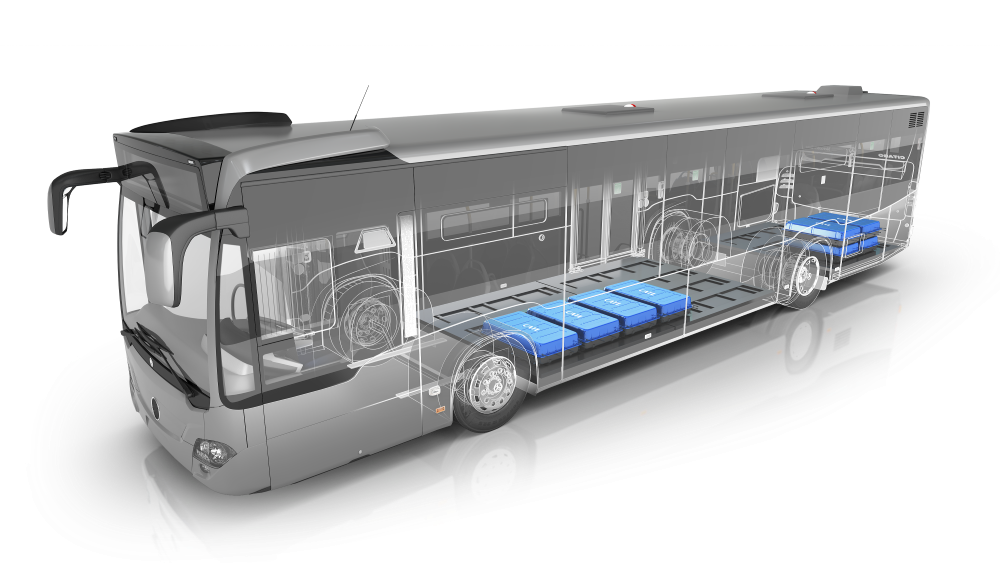
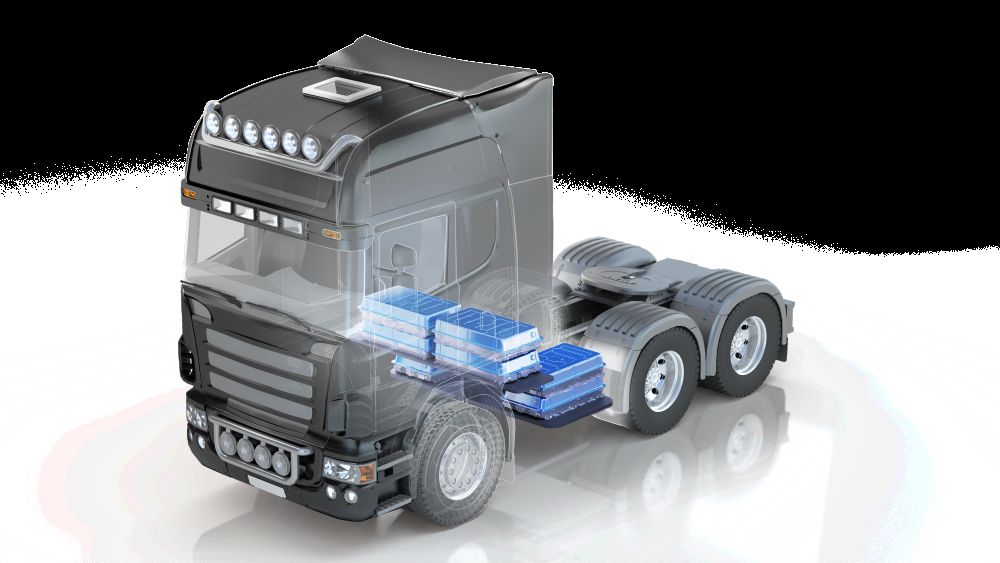
The pack is built on TECTRANS II, a modular platform designed for a wide range of commercial vehicle applications. By configuring different numbers of standardised packs, OEMs can match energy capacity and payload to each use case. The platform works with both e-axle and central-drive architectures and supports both plug-in charging and battery swapping. External dimensions, electrical interfaces and communication protocols are standardised, while battery technologies and pack designs can continue to evolve. As a result, new and existing vehicle models can adopt future upgrades without major changes to the vehicle platform. Manufacturers also no longer need to develop a dedicated battery system for each model, which lowers early-stage investment risk and speeds up launches, a company official said.
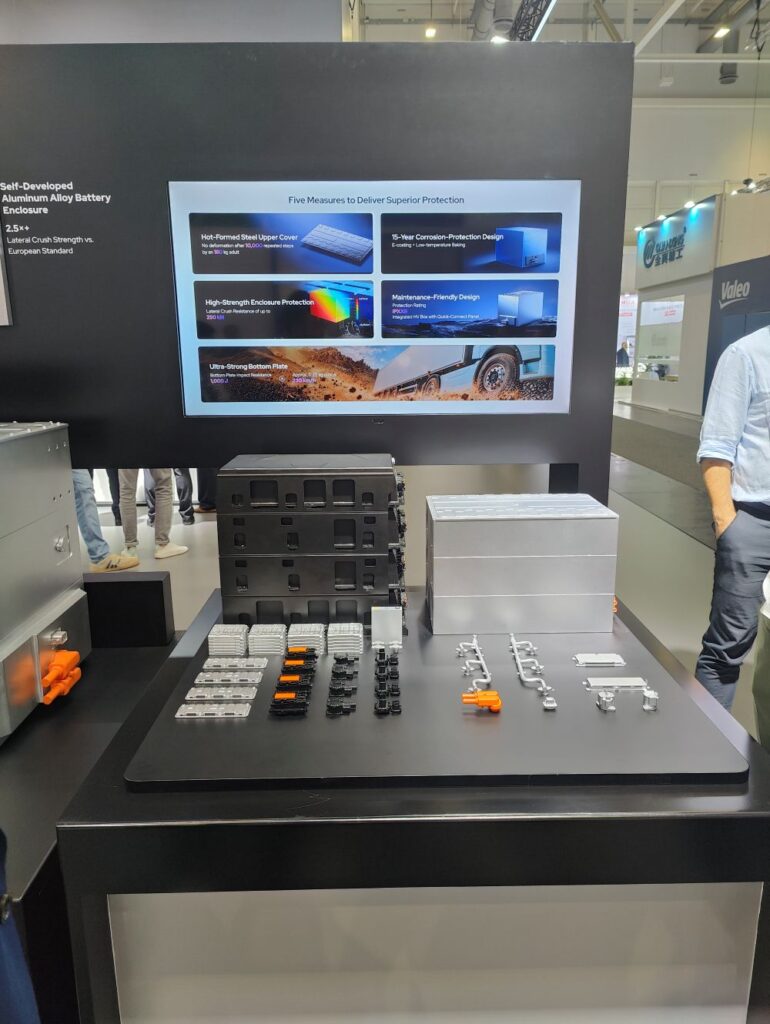
Inside each pack sit 198 cells based on CATL’s fifth-generation lithium iron phosphate (LFP) technology. The company uses smaller, more highly compressed particles, ranging from 50 to 3,000 nanometres, to pack more active material into each cell. This raises energy density and enables faster charging. Batteries typically expand, or “bulge,” as they age, so to protect durability CATL has developed a “low rebound” anode material that limits expansion over repeated charge cycles. Less expansion means a longer usable life. Further refinements include a more stable solid electrolyte interphase (SEI) layer, which reduces unwanted chemical reactions within the cell. A redesigned terminal plate frees up internal space, even a single millimetre, for more active material. Ceramic-coated separators between the anode and cathode resist turning brittle in the cold or softening in the heat, keeping safety performance consistent across a wide temperature range.
Lifecycle Economics
According to a company official, the design improves fleet economics in three ways. The first is energy density. A single pack delivers 140–143 kWh, and at 170 Wh/kg, around 13% above the industry average, it lets trucks carry roughly 0.6 tonnes of additional payload for the same battery capacity. The second is range and charging. A full seven-pack configuration delivers 900–980 kWh, giving a range of up to 1,000 km, and megawatt-level fast charging takes the battery to 80% in 25 minutes, minimising downtime on long-haul routes. The third is efficiency, which CATL calls the world’s first full-tab, low-impedance design delivering 96% system round-trip efficiency, three percentage points above the industry average, which reduces charging losses and leaves more usable energy for daily operations. The battery is also engineered for a 12-year, 1.5-million-km service life with 70% capacity retention, supporting stronger residual values for fleet assets.
Safety and Reliability
Safety has been built in at several levels. A dynamic multi-pack battery management system runs the packs in parallel on a shared voltage platform. If one pack develops a fault, such as thermal runaway, the system isolates it automatically and the vehicle keeps running on the remaining packs.
Physically, a hot-formed steel upper cover can withstand being stepped on 10,000 times by a 180-kg adult without deforming. The bottom plate offers 1,000 joules of impact resistance against road strikes. An extruded-aluminium enclosure with crush-resistant ribs provides lateral crush strength of up to 250 kN, meeting Europe’s R95 regulation.
CATL also offers 15-year corrosion resistance, supporting long-term operation in coastal and cold regions. On the digital side, multi-layer protection covers chip hardware, software and the vehicle system, and development follows international information security standards. For servicing, the pack maintains IPXXB protection whether the main connectors are connected or disconnected, improving high-voltage safety during maintenance.
The company sees commercial vehicle electrification as the third wave of the global energy transition. It aims to work with partners worldwide across products, energy, services and the wider ecosystem to catch that wave.