
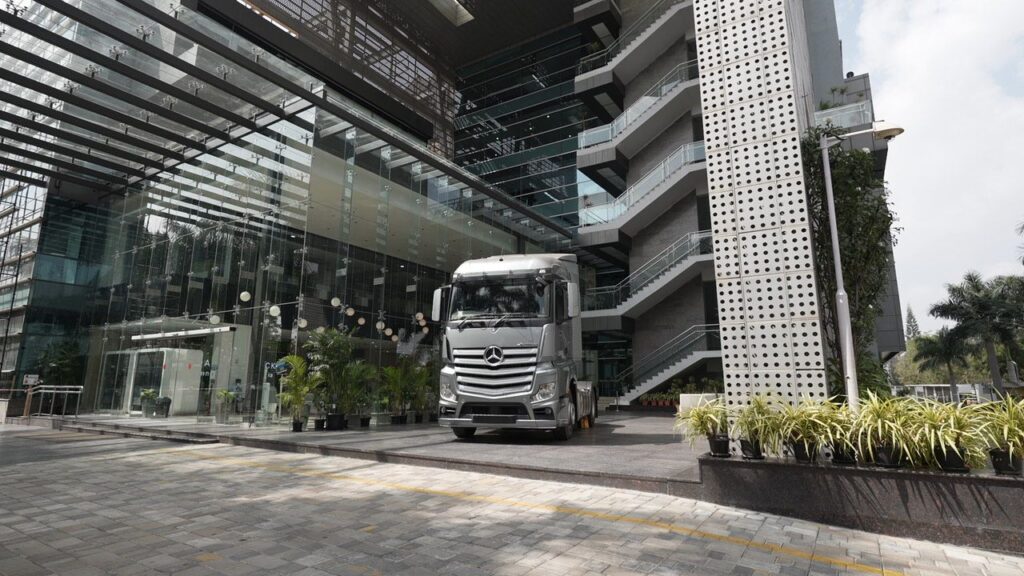
From an app used by Daimler Truck fleets, across different markets, to tracking that updates in seconds and a role in planning driverless trucks, Daimler Truck Innovation Centre India (DTICI) has grown from a support team into a strategic one.
A truck owner in Europe wants to leave on time. Before she reaches the vehicle, she opens an app. She finds a parking spot, cools or warms the cab from her phone, and runs a quick check on the lights and sensors. She has not yet touched the truck. That app, ‘Remote Truck,’ was fully built and released from DTICI in Bengaluru, and it is now widely used in Europe. The same team also built the platform behind it.
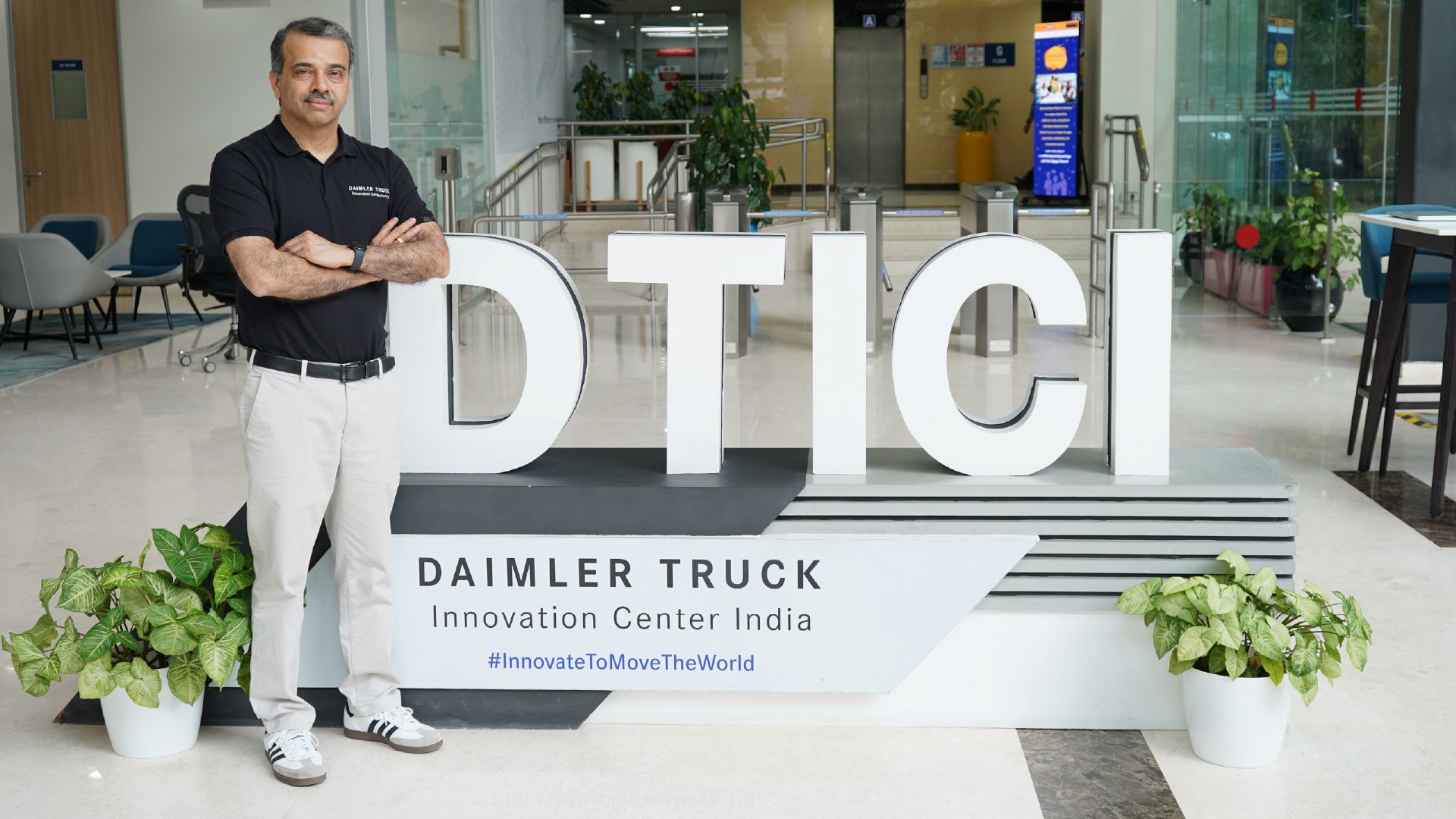
DTICI has had its present identity since 2021, when it separated from Mercedes-Benz Research and Development India. Speaking to this publication, Mr. Radhakrishnan Kodakkal, MD & CEO of DTICI, said, the tech centre has grown from an engineering support centre into a “truly strategic technology centre” for Daimler Truck. He wears two hats: he leads the India centre and also runs connectivity and digital services for Daimler Truck globally. He explained that the centre’s work in three parts: the vehicle itself, the software that sits on the hardware, and digital services that keep adding value after the truck is sold. Its core skills are software, digital tools, virtual product development and IT.
Tracking in Seconds, not Minutes
Another product from the centre is TrucKonnect, a telematics and connected-vehicle fleet management platform. Mr. Kodakkal listed three recent improvements. First, the team rebuilt how fuel fills and drops are detected, reading whole streams of sensor data in one pass instead of record by record, which makes detection faster and more accurate. Second, customers now get vehicle data pushed to them as a continuous stream, replacing the older approach where they had to ask for it. Third, a lean data path built on a database designed for time-based data cut the delay in showing a truck’s live location from 7–10 minutes to under 5 seconds.
The centre also provides “data as a service” for large logistics companies, especially in the US. Such companies may run many fleets and want their own fleet management apps. This creates new revenue streams and can lower service costs, especially for maintenance, he said.
Testing without Test Track
When asked how much time the centre has saved in the new product development cycle, Mr. Kodakkal said he could not give a percentage, because the answer differs between a brand-new vehicle and a smaller update. For software features, he said, the reduction in lead time is significant and continuing.
The centre helps by moving more testing onto computers. For electronics and software, it uses hardware-in-the-loop and software-in-the-loop testing, where real or simulated parts are tested automatically. For the vehicle, simulation checks the design, including how easy it is to manufacture and how long it will last. The best results so far are on “derivatives,” smaller variations of a major vehicle that do not need much physical testing. However, there are limits, he said, adding that for a whole vehicle, safety and regulatory rules still require running it on a test track or outside to gather evidence; therefore, some physical testing cannot be skipped.
Inside the Big Bets
The centre has a role in several of Daimler Truck’s largest projects. In driverless trucks, the American firm Torc provides the base technology, and DTICI helps bring it into Daimler’s own software ecosystem and validates the software. He noted that a driverless long-haul fleet using Torc and the Freightliner Cascadia platform is planned for North America towards the end of this year. In ‘coretura,’ a joint venture with Volvo Group to build a common software system for trucks and buses, a DTICI team manages the central computer that runs the vehicle. This lets Daimler Truck add its own features, such as safety and driver assistance. Mr. Kodakkal saithe aim is to separate software from hardware completely, so new features reach trucks faster, and that differentiation depends on how a feature is brought to market and sold, not only on the feature. In fuel cells, the core technology sits in ‘cellcentric,’ an equal partnership with Volvo and Toyota. DTICI does not work on the cell itself; instead it handles the software that monitors and controls the vehicle, along with digital services such as charge status, efficiency and remaining time.
Using AI Prudently
Mr. Kodakkal said the centre uses AI to “amplify” people, so it can do more with the same number of staff, but a human must always check the result. He described a three-part recipe: trusted data, AI & Machine Learning, and domain expertise. He also described layers of AI. The base is physics-based and mathematical models. On top come Machine Learning in a controlled setting, and then large AI models for tasks such as studying how a million connected trucks are performing. The guardrails, he said, are there “so that you are not blindly dependent on AI.”
The Indian Way to Cut Costs
Asked about the high cost of electric trucks in Europe, Mr. Kodakkal said the centre looks at the cost of the vehicle itself. He says Indian engineers bring a frugal mindset, and the centre pairs it with a method called TRIS – Theory of Inventive Problem Solving. This helps teams resolve trade-offs, such as using a new material that costs less but must still be strong and stiff. Ideas generated in India are then checked with teams in Germany and the US.
The Electric Challenge
Pointing out to the fact that electric trucks are only about 2.2% of the market in Europe, against a target of 35% by 2030, Mr. Kodakkal said the shift depends on three things: the trucks themselves, better batteries and charging infrastructure. Range matters most for long-haul work. City buses are moving to electric faster, because their routes are in cities. Daimler already has electric trucks and buses in series production, and he said infrastructure is a joint effort between vehicle makers, logistics firms and governments, including the European Union.
Mr. Kodakkal came back to one point. A truck or bus stays with its owner for more than ten years. That is why DTICI is focused not just on building the truck, but on keeping it improving for as long as it is on the road.