
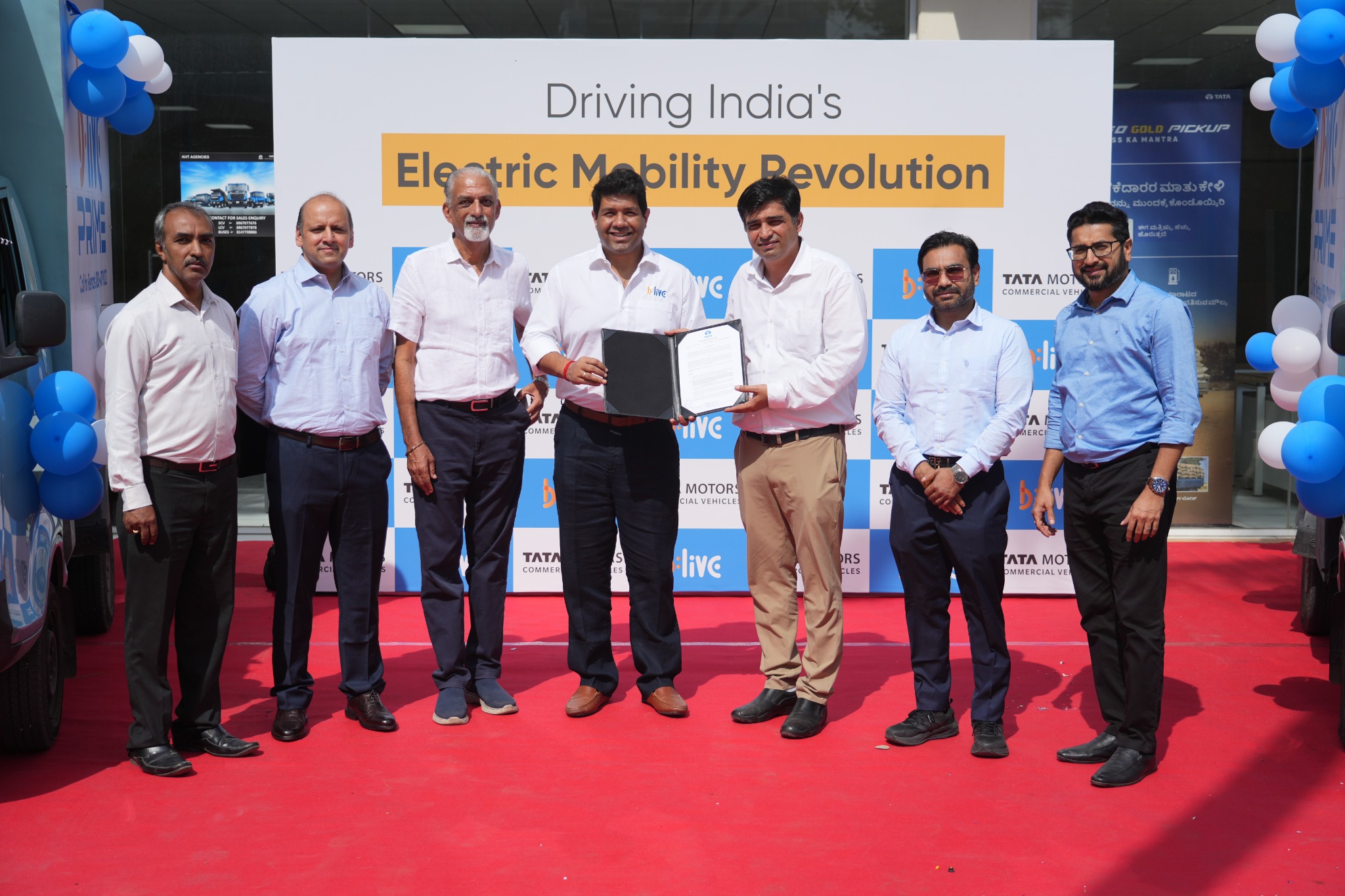
BLive, India’s leading integrated commercial EV mobility platform, has signed a Memorandum of Understanding (MoU) with Tata Motors, India’s largest commercial vehicle manufacturer, to deploy up to 1,000 Tata electric mini trucks through BLive PRIME, its franchise-owned commercial EV fleet programme. The planned rollout is part of the company’s strategy to build scale in India’s fast-growing Cargo EV segment and accelerate the electrification of last-mile and intra-city logistics. The company has recently introduced BLive PRIME with a ₹100 crore investment dedicated to large-scale electric fleet adoption and advancing the nation’s green delivery revolution.
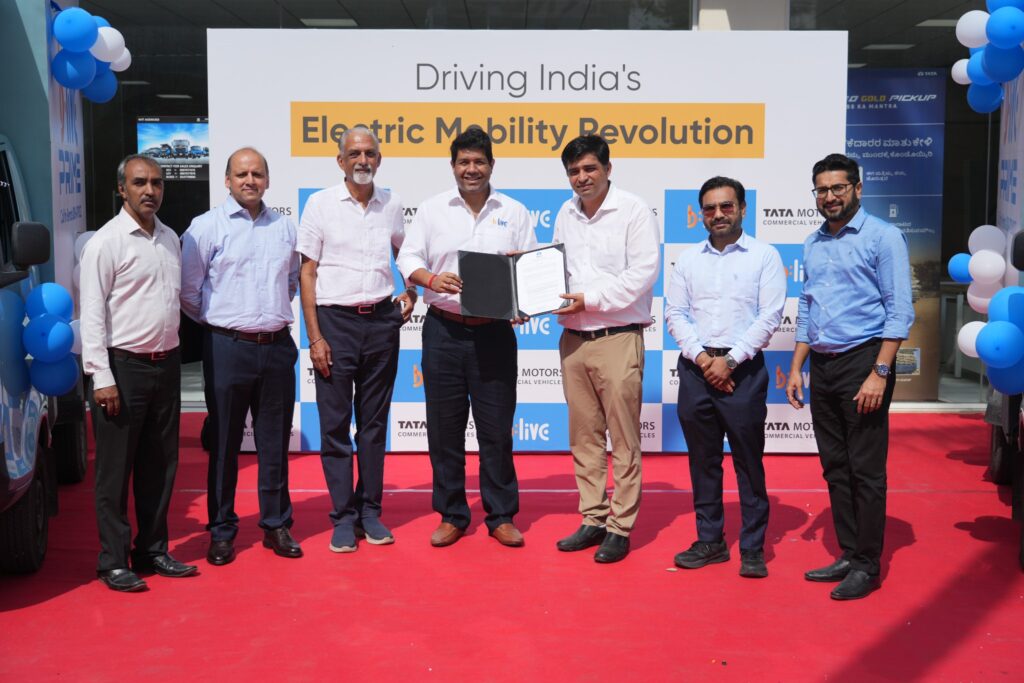
Prashanth Rao, CEO, KHT Agencies; Kapil Nijohn, Regional Manager,SCVPU Business,South, Tata Motors; Kirit Morzaria, Dealer Principal, KHT agencies; Sandeep Mukherjee, Co-founder & CEO, BLive ; Yogesh Sharma, Zonal Head, Commercial Vehicle Business, South, Tata Motors; Sudipta Sarkar, Head-EV Sales and Product Marketing, SCV at Tata Motors; Manveer Shetty, EV Zonal Lead, South India, Tata Motors.
As the first step under the partnership, BLive has inducted the first batch of Tata Ace Pro EVs, marking the start of on-ground deployment. The initial fleet will be used for enterprise logistics operations, with subsequent batches to follow in phases over the coming months. Through BLive PRIME’s franchise-owned fleet programme, entrepreneurs and businesses can invest in and own a fleet of electric cargo vehicles, starting with an investment of approximately ₹45 lakh, and earn assured rentals from the deployed fleet. BLive manages the end-to-end fleet lifecycle, including enterprise demand, vehicle deployment, fleet technology, charging ecosystem integration, maintenance and day-to-day operations, creating a professionally managed commercial EV ownership model.
Mr. Sandeep Mukherjee, Founder & CEO, BLive, said, “The Cargo EV segment is experiencing strong demand as businesses increasingly evaluate electric fleets for their intra-city logistics requirements. However, scaling commercial EV adoption requires more than vehicle availability. Enterprises need access to reliable fleets, charging, technology, maintenance and professionally managed operations. Through our franchise-owned fleet programme, we are enabling entrepreneurs to own productive electric cargo assets and earn from fleet rentals. At the same time, BLive manages enterprise deployment and end-to-end operations. Our plan to deploy more than 1,000 Tata Ace EVs reflects our ambition to build scale and establish BLive as a leading player in India’s Cargo EV segment.”
India currently has an estimated 4.5-5 million Light Commercial Vehicles (LCVs) on its roads, with the vast majority still operating on diesel. Electric penetration in the cargo LCV segment remains below 1%, highlighting the significant headroom for electrification and the scale of the market opportunity. BLive plans to deploy its franchise-owned electric cargo fleets across high-growth sectors including manufacturing, warehousing, e-commerce, quick commerce, retail distribution, FMCG, construction, pharmaceuticals and third-party logistics (3PL).
Mr. Pinaki Haldar, Vice President & Business Head-SCVPU, Tata Motors Ltd., said, “We are pleased to partner with BLive as it expands electric cargo mobility solutions. With the Ace Pro EV, an accessible and efficient solution for small businesses, the proven Ace EV for last-mile logistics, and the high-performance Intra EV for larger cargo applications, Tata Motors offers a comprehensive electric SCV and pick-up portfolio to address diverse customer needs. Together, we are enabling businesses to adopt sustainable mobility solutions that deliver productivity, reliability and strong operating economics.”
The expansion comes as India’s commercial logistics industry is experiencing strong demand for electric cargo vehicles, driven by the rapid growth of e-commerce, quick commerce, organised retail, manufacturing and urban supply chains. Businesses are increasingly evaluating electric commercial vehicles to reduce operating costs, meet sustainability commitments and improve the economics of high-utilisation intra-city logistics.