

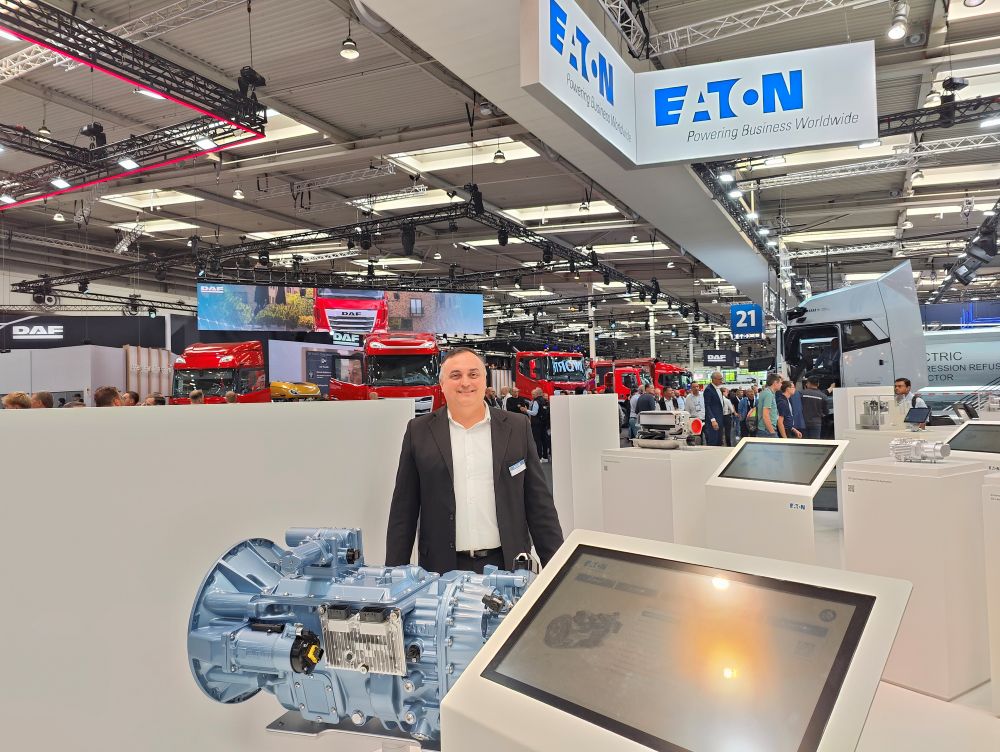
Intelligent power management company Eaton has proved that there is still plenty of life left in the combustion engine, even as it prepares for hydrogen and electric trucks. At IAA Transportation 2026, the company showcased its Turbulator cooling valve, the DURA4TRAK transfer case for light- and medium-duty commercial vehicles, a full family of Advantor automated manual transmissions (AMTs), and its Late Intake Valve Closing (LIVC) technology, which has been selected for commercial vehicle engine programmes in North America, Europe and Asia.
A New Job for an Old Favourite
Speaking to this publication, Mr. Marcos Janasi, Global Product Line Director – Commercial Powertrain, Mobility Group, Eaton, said the company’s supercharger was originally built for petrol passenger cars, where it delivered instant boost. Because it is driven directly by the crankshaft, it has no turbo lag. As the car market shifted its focus to emissions and fuel economy, demand for it fell. Now Eaton has found it a new role in hydrogen engines for heavy-duty trucks.
Hydrogen engines need a lot of air, and at some engine speeds a turbocharger can’t supply enough. A supercharger fills that gap, and Eaton says it has evidence that this lets a hydrogen engine match the performance of a diesel. A much smaller supercharger solves another problem. The mini supercharger works as a pump, constantly venting the crankcase to keep hydrogen levels safe.
A Valve That Keeps Its Cool
The engine valve is one of Eaton’s oldest products, and the Turbulator gives it a clever upgrade. It is a hollow valve filled with sodium, which carries heat away as it sloshes around inside. In commercial vehicle engines, which run at lower speeds, the sodium doesn’t move as much. So, Eaton placed a small piece of metal inside the cavity that moves up and down with the valve, stirring the sodium and helping it shed heat. Because the metal piece is surrounded by sodium rather than rubbing against the walls, it doesn’t create friction. Eaton’s tests show it lowers the valve temperature considerably.
Smarter Braking from the Engine
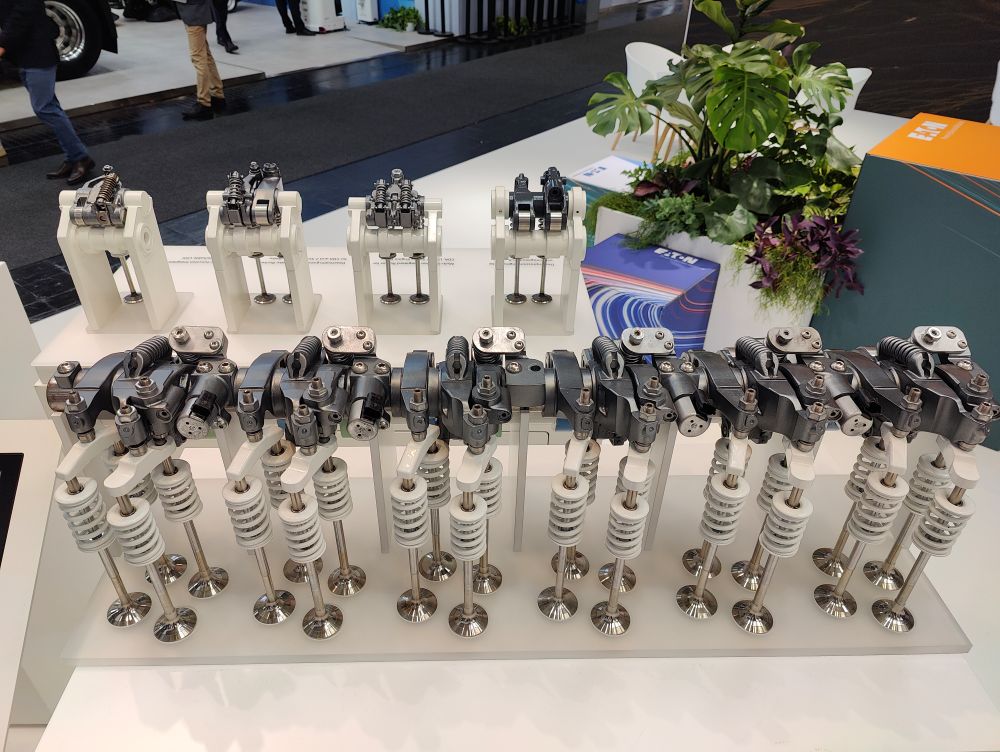
Eaton also showed its valvetrain technology, which controls how engine valves open and close. Its 1.5-stroke decompression engine brake turns the engine into a brake to help slow the vehicle, easing the load on the service brakes. It works by switching off the main exhaust valve lift and switching on a second lift designed only for braking. The system is already in production on commercial vehicles. The same switchable roller idea also lets engine makers choose between two different valve lifts on one rocker arm.
The newest development, now in testing, combines hydraulic lash adjustment with the decompression brake. Eaton says nothing comparable exists on the market. It means the valve clearance never has to be set manually, saving time on the assembly line and trips to the workshop for owners. This is especially helpful on tractors, where the after-treatment system often sits above the engine and has to be removed just to adjust the valves.
Transmissions for Every Load
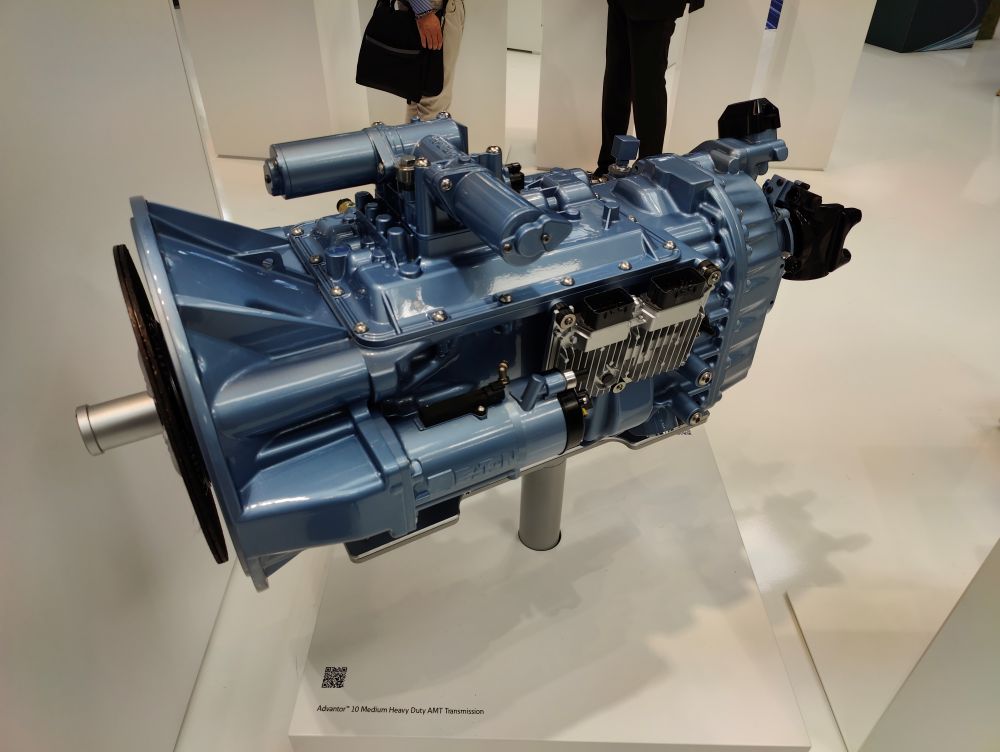
Mr. Janasi also introduced the Advantor AMT family. It comes in 6-, 8- and 10-speed versions covering vehicles from five tonnes up to 55 tonnes. All three share common components, and because the parts are separate rather than sealed in one pack, they are easier to service. The transmissions also run on all-new software designed for better performance.
Advantor is launching at the same time in Brazil and India, where it is produced at Eaton’s plant in Ranjangaon, Pune. According to Mr. Janasi, it offers up to 10% better fuel economy than a manual gearbox and two to three times longer clutch life, lowering the total cost of ownership. “We still believe we can continue improving efficiency in the combustion engine powertrain,” he said.
Rounding out the line-up is the DURA4TRAK, the first transfer case Eaton has developed in-house with more models planned over time.
Keeping EVs Safe and Powered
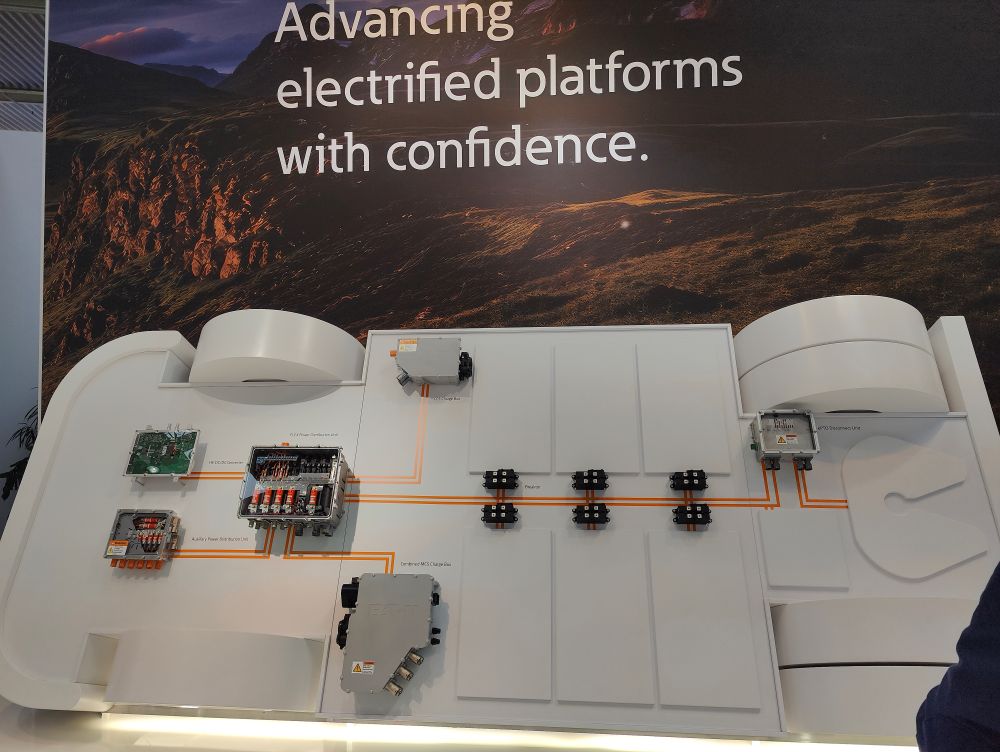
For electric vehicles, Eaton focuses on distributing and protecting power from the battery. Alongside its well-known Bussmann fuses, it offers Breaktor circuit protection technology, which combines a fuse and a switch, or contactor, in one unit. A normal fuse must be replaced after it blows, which means downtime. The Breaktor cuts the circuit during a fault, then reconnects once the battery management system says it is safe.
The range also includes the Flex power distribution unit, which customers can configure to suit their vehicles, and a megawatt charging box that handles up to one megawatt, 1,000 amps and 1,000 volts. There are also DC-DC converters that step down 800- or 400-volt power to 12 volts, along with high-voltage connectors. For buses, a pure sine wave inverter provides smooth, reliable AC power from regular plug points, so passengers can charge laptops on the road.
Eaton also displayed a heavy-duty four-speed EV transmission made in Pune. A single-speed gearbox is enough for lighter vehicles, but trucks and buses benefit from multiple gears, balancing cost and efficiency.