
Microchip Technology has introduced the SAM9X75D5M System-in-Package (SiP), aimed at supporting the growing demand for advanced Human-Machine Interface (HMI) systems in automotive and e-mobility applications. The new device integrates an Arm926EJ-S processor with 512 Mbit DDR2 SDRAM, offering a compact and efficient solution for modern vehicle display systems.
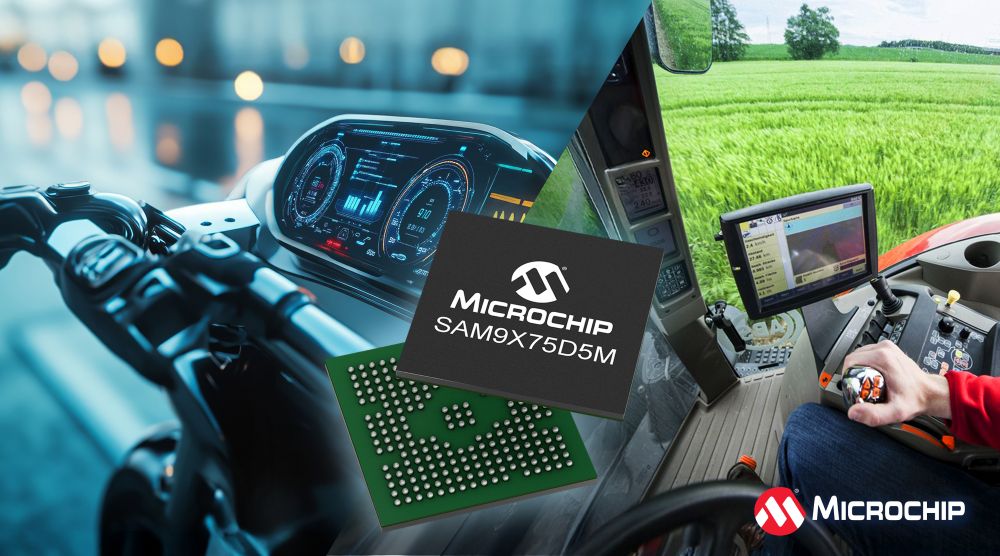
Qualified to AEC-Q100 Grade 2 standards, the SAM9X75D5M is designed to support large display sizes of up to 10 inches with XGA resolution (1024 × 768 pixels). It is targeted at applications such as digital cockpit clusters, smart clusters for two- and three-wheelers, HVAC systems and EV chargers.
Part of Microchip’s hybrid MCU family, the SiP combines the processing power of a microprocessor with the simplicity of MCU-based development environments. This enables developers to leverage higher memory density and performance while continuing to use familiar tools and Real-Time Operating Systems (RTOS).
A key highlight of the solution is the integration of DDR2 memory within the package, which simplifies PCB design, reduces routing complexity and mitigates risks associated with sourcing discrete memory components. The single-chip approach also ensures better supply stability and long-term reliability.
The device supports multiple display interfaces, including MIPI DSI, LVDS and parallel RGB, and offers advanced connectivity options such as CAN FD, USB and Gigabit Ethernet with Time-Sensitive Networking (TSN). Integrated 2D graphics and audio capabilities further enhance its suitability for modern in-vehicle HMI applications.
According to the company, the SAM9X75D5M is designed to help engineers develop compact, high-performance systems while balancing cost, power efficiency and scalability. It also provides a migration path for applications moving from traditional microcontrollers to more advanced processing platforms.
The new SiP is supported by Microchip’s MPLAB X Integrated Development Environment and MPLAB Harmony Software Framework, along with a range of graphics development tools. Evaluation is enabled through the SAM9X75 Curiosity LAN Kit, allowing developers to accelerate design and deployment.