
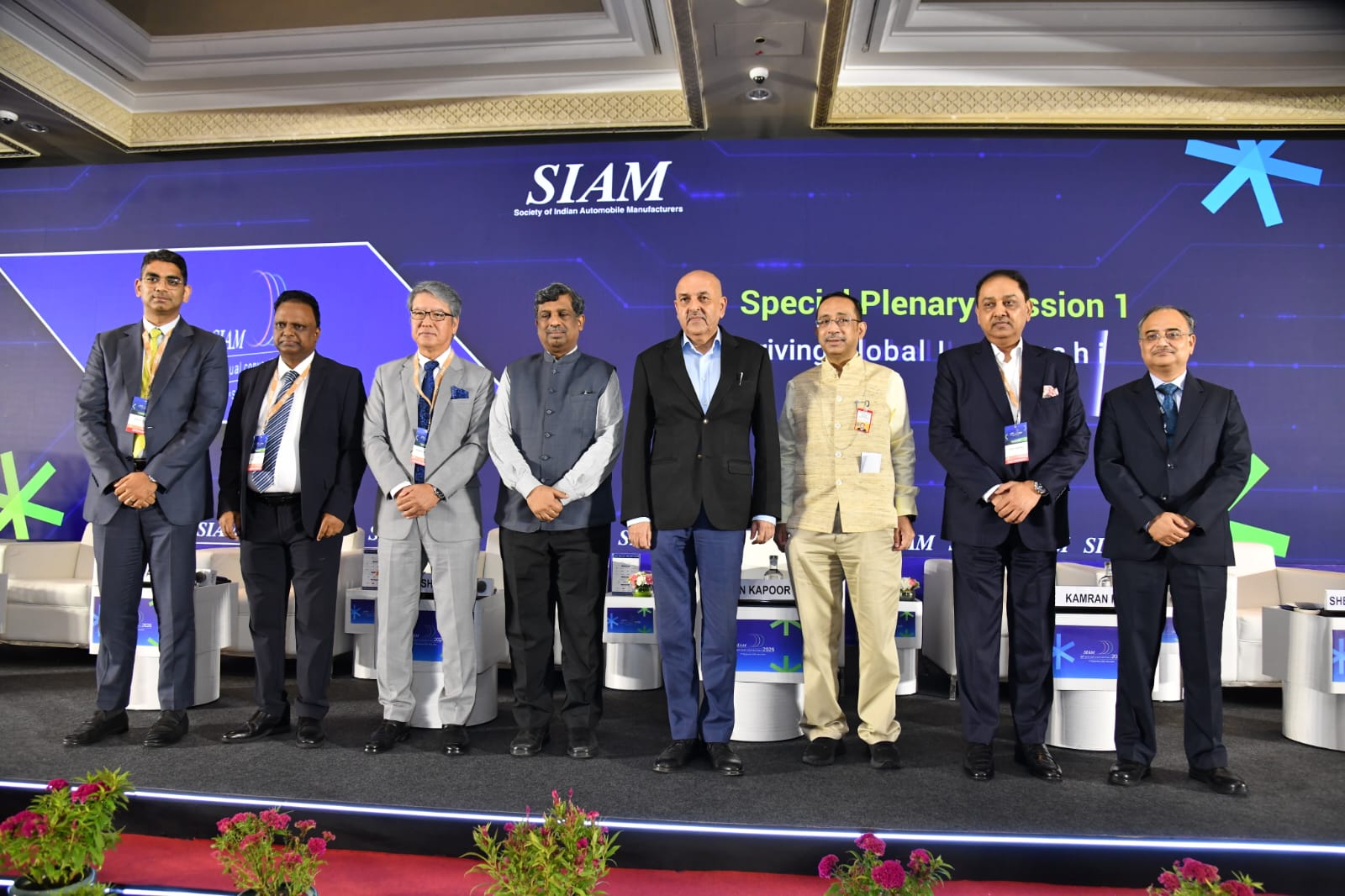
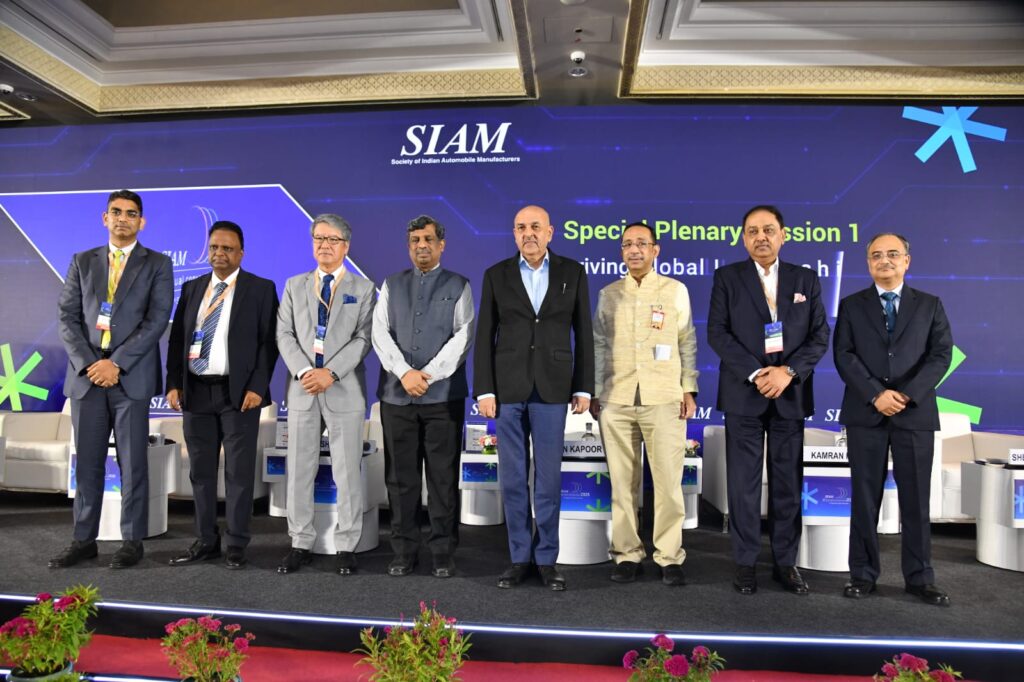
The 66th Annual Convention of the Society of Indian Automobile Manufacturers (SIAM) opened with a high-powered Special Plenary Session themed “Driving Global Leadership in Sustainable Mobility,” bringing together senior government officials, industry leaders, and global automotive executives to discuss India’s ambitions in sustainable mobility by 2047.
Government Sets the Direction
Mr. Tarun Kapoor, Advisor to the Prime Minister, Government of India, acknowledged the automotive sector’s critical role in the economy and laid out a clear direction for the road ahead. “India’s mobility transition must accelerate towards cleaner fuels, with electric, biofuels and green hydrogen shaping the way forward. We must strengthen charging infrastructure, transition heavy vehicles to electrics, build our export ecosystem and make India a global hub for advanced mobility technologies and manufacturing,” he said.
Mr. V Umashankar, Secretary, Ministry of Road Transport and Highways, highlighted the government’s PARIVARTAN scheme for commercial vehicles in the Delhi-NCR region, describing it as gaining momentum and capable of transforming the segment in the region. “The auto sector represents a growth story that is unparalleled, driven by strong collaboration amongst all stakeholders,” he said.
Mr. Kamran Rizvi, Secretary, Ministry of Heavy Industries, traced India’s electric mobility journey from FAME to PLI, noting that government support has been consistent throughout. “Over the next 10 to 15 years, the scales will be tipped towards electric mobility. We need to shorten the catch-up time in technology. We need to become inventors of technology,” he said.
Industry Voices — Affordability, Alternate Fuels and AI
Mr. Hisashi Takeuchi, Managing Director and CEO, Maruti Suzuki India Ltd., spoke about the role of affordability in expanding car ownership in India, noting that GST reforms have made mobility more accessible to first-time buyers. “India is making strong progress on sustainability while keeping mobility affordable and strengthening its alternate fuel ecosystem. With CNG and biofuels available at scale, India is reducing its dependence on fossil fuels significantly,” he said.
Addressing the session virtually, Mr. Ola Källenius, CEO, Mercedes-Benz Ltd. and President of the European Automobile Manufacturers’ Association (ACEA), highlighted global experiences of leveraging AI in sustainable mobility. “India has the largest R&D centre outside of Germany, a key local production hub for ICE and EV, and takes a front seat in our industry’s global transformation, from voice assistants to automated driving. Together, India and Europe can shape the digital future,” he said.
AI as a Driver of Sustainable Mobility
The session also featured a presentation by McKinsey & Company on leveraging AI for driving global leadership in sustainable mobility, delivered by Mr. Nitesh Gupta, Senior Partner, McKinsey & Company. Mr. R Velusamy, Chairman, SIAM Passenger Vehicle CEOs Council and President — Automotive Business, Mahindra & Mahindra Ltd., highlighted how India can utilise AI to drive innovations that foster sustainability in the Indian automobile sector.
Mr. Shenu Agarwal, Vice President, SIAM and Managing Director and CEO, Ashok Leyland Ltd., was also present during the session. The discussions underscored a broad consensus — that India’s path to global automotive leadership will be built on the twin pillars of technology and sustainability, with collaboration between government, industry, and global partners at its core.
Valedictory Address
Mr. Piyush Goyal, Union Minister of Commerce and Industry, delivered the valedictory address at the convention. The session highlighted India’s automotive industry’s potential to navigate shifting global trade dynamics, strengthen competitiveness, and expand its global footprint.
Mr. Goyal said, “Bharat Mobility Global Expo has sparked strong momentum, and that reflects the resilience of our automotive industry highlighting where technology is headed. With India’s trade agreements opening new markets, we must set higher export targets and leverage the 4Ms — molecule, module, megawatts and markets — to build trusted global partnerships. India’s reforms and strengthening ecosystem are being noticed worldwide, and this is the right time to reshape the sector and strengthen self-sufficiency to help build a developed India by 2047.”
Mr. Sriram Viji, President Designate, ACMA and Managing Director, Brakes India Pvt. Ltd., delivered the concluding address, highlighting the key takeaways from the Convention and the way forward for India’s automotive industry.
The Convention reaffirmed the growing strength of India’s automotive sector and its potential to emerge as a global leader in next-generation mobility.